Showing posts with label Couplings. Show all posts

Saturday, 30 May 2026

Getting Closer

This is not a groundbreaking development in the world of model railways, but it is a classic case of us being late adopters.

Himself is experimenting with magnetic couplings for the intermediate connections on our carriage sets.


We use Kadees for the primary coupling to the locomotives but had kept tension locks on stock which is intended to run in fixed formations.

On a layout with a small element of gradient, there can be obvious fore and aft movement as the passenger trains move through the dip on the Cambrian line at the front of the layout, at the bottom of the photo here.


We designed it this way to help emphasise the embankment carrying the long siding in the yard, and also because in reality Minffordd is a summit and there is a steep descent towards Porthmadog.

A fixed magnetic link will eliminate this distracting movement of the carriages, and should also shorten the space the carriage sets take up in the fiddle yards by a few mm's.

It doesn't sound a lot but there is only 'fag paper' clearance sometimes when you have a full three-car rake and a locomotive on each end.

Friday, 14 December 2018

Customer Service

The old adage goes that the customer is always right, even when they're wrong.

When I'm building models to order I always do my best to try to meet my clients requirements, even when it sometimes makes things a little more awkward.

Take the case of the couplings on the latest batch of wagons which are just about finished.

The customer has standardised on couplings designed by PECO for their ready to run range of rolling stock..

Standardising in this way makes things much easier  - but fixing plastic parts to brass? Not so much...


The etched bogie frames I use on my kits work best with the brass Greenwich couplings, which can be soldered direct onto the tongue which extends out from the middle.  Or failing that the Bemo ones with a long shaft which gives you plenty of surface area to glue them on.

These PECO couplings are designed to slot into NEM pockets, and have almost no shaft on them.

They're also made from the kind of plastic which doesn't work with Superglue.

So the solution I've had to adopt is, firstly, to solder on a brass extension piece onto the bogie, and then use epoxy resin to attach the coupling, which is less than ideal because it takes an age even for the rapid stuff to set hard.

It's done, however, so now all I have to do is fix on the resin detail parts on the side of the bogies (it seemed sensible to wait until I'd finished the soldering work) and then spray them.


Wednesday, 11 May 2016

Greenwich, Meantime

I've had a change of plan with what to do next on the carriage.

Instead of adding the vacuum pipes I got out the soldering iron and added the couplings to the bogies the other night.


We have standardised with the fold-up brass Greenwich couplings on our rolling stock and they are the default option for any stock I am building for a client too.

Among their advantage is that it is very simple to re-position them, you just apply the hot tip of the iron and melt them off and fix them back in place.

I don't know what the client has planned for his Disco Car yet, and whether it will ever run on a layout as part of a train, so it is hard to know whether to set them in a close-coupled position or not.

So I have played safe and set them very generously so to reduce the chances of things like the corridor connections or the vac pipes locking with those on any other stock it is coupled do.

It's possible, after all, that it may make a guest appearance on Dduallt or Bron Hebog one day.


Monday, 26 January 2015

Tongue Tied

I've been building a trio of SAR wagons for a client who wanted them ready to run complete with couplings.

On his layout he's fitting all his stock with the new coupling PECO has developed for its L&B coaches and wagons which are designed to locate in a NEM pocket.

The task for me was to work out how to fit them to my resin wagons / brass bogies and get them set at the correct height.

My bogie design has a brass tongue which extends from the stretcher and, on our rolling stock, this is where we solder on the long shaft of the brass, fold-up Greenwich couplings which we are now fitting as standard on Bron Hebog.

It works well too with the old Bemo couplings which have a long plastic shaft which can be glued on.

The PECO ones, however, have a very short shaft because they're designed to clip into the pockets and a test run gluing one of them onto the end of the brass tongue on my bogies showed it was a whisker too short and there wasn't quite enough clearance for the coupling loop to rise as high as I'd like.

So what I've decided to do is solder a small extension onto the tongue using some offcuts from old brass frets - yet again proving the value of being canny about what you throw away.


My customer also sent me a PECO RTR wagon to enable me to set the coupling heights properly.

As lucky would have it the brass tongue is in almost exactly the right position and can be easily bent up or down a bit as required.


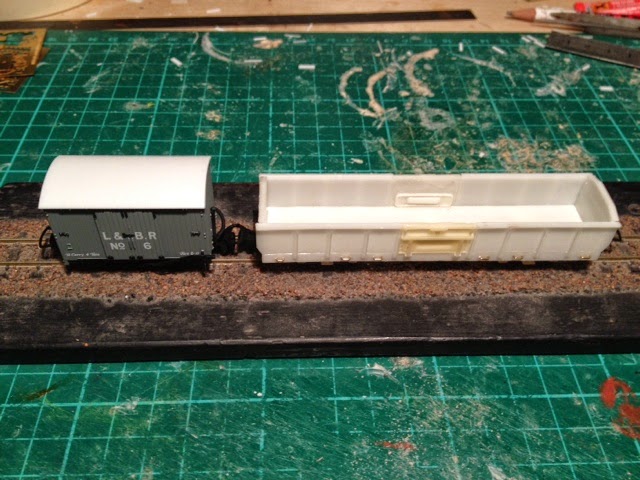
And here is is with one of the B wagons sitting on its bogies.


There's nothing like the satisfaction of a successful adaptation.