Showing posts with label PECO. Show all posts

Tuesday, 17 March 2026

Flea Bites

Last week I posted about the 'Barn' carriages in their short-lived varnished wood livery which were scratch built for the Minffordd project.

They are one of three core passenger trains which we run on the main line which traverses the back of the scene.

The one which most people probably associate most with the FR is the short train of the historic four-wheelers known in the period as the 'Flying Flea'.


This began as an unadvertised relief train cobbled together to cope with the surge in passenger numbers the railway reopened to Tan y Bwlch in 1958.

It only lasted for a couple of years in this form, so, historically, the heyday of the 'Flea' is a before the period setting for our layout.

Later in the 1960s the four-wheel carriages were mostly added to the top of trains of bogie carriages as strengtheners.

However, it helps us operationally to have three carriage sets to rotate, and it's also a fun little train to run, particularly with a single engine at the head of it.

To get a consistent look we decided to use the RTR PECO 'bug boxes' for this set, instead of the brass kits we have for the carriages on Dduallt.

The Quarrymen's carriage was made from a Dundas plastic kit because during this time the last survivor, number 8, had been repaired with plain plywood, rather than the historic matchboard sides which is how PECO produced theirs.

The same is true for brake van number 2, which I also had to kit-bash.

That is sometimes marshalled on the end of this set as the guard's vehicle, or, as in the photo above, it may be running with the new van 1 which was among the first brand new passenger vehicles on the FR in the revival era.

This model was scratch built in styrene and running on a Dundas Quarrymen's chassis.

It makes such a fun contrast to the large standard gauge trains passing underneath on the Cambrian line and, I hope, adds to the charm of the layout for a casual viewer.

Tuesday, 3 March 2026

Getting It Straight

When we set out to make Minffordd it was with the intention to make as much use of ready-to-run rolling stock as we could.

That may seen an odd approach for a layout team best known for amassing a huge collection of kit built and scratch built stock but we wanted to get it made as quickly as we could.

Wanting to have DCC sound on the layout was the other major consideration - so much easier with RTR!

However, there were still some locos which required some serious hacking about to be correct for our era, and one of them was Prince.


The era we are modelling Prince in the 1960s is the period where 'The Old Gent' was going through something of a mid-life crisis.

He hadn't yet started bulking up on the steroids - that came in the 1980s - but to try to keep up with the younger Ladies who appeared on the railway the decision was made to strengthen his frames and take out the classic step up beneath the saddle tank.

This look, which lasted for less than a decade, wasn't included in the 'tooling suite' for the Peco / Kato Small England so it was necessary for us to take the knife to it.

The good news is that the body breaks down into sub-assemblies, and the frame is one of these.

It was a relatively simple job to chop out the stepped-up section and join the two halves back together with some thin brass strip and fix the saddle tank section back on top.

To be completely authentic we also filed away the ballast weights in front of the smokebox and the resulting hole was disguised with some brass shim.

As the loco had to be completely disassembled in any case to hard wire in a DCC chip it didn't mean that much extra work.

Prince has come to be perhaps our most essential locomotive for operating Minffordd Yard because - on account of his traction tyres (I might have been wrong about those....)-  he's the only loco which can haul a full rake of wagons up to the Mineral Line,  all the rest have to drag them up a couple at a time and assemble the rake in the siding at the top.


Wednesday, 21 June 2023

Pulling Apart A Prince

Even though 009 is fast becoming a ready-to-run scale its good to know that some old fashioned modelling is required to produce the appropriate locomotive fleet for our Minffordd layout.

A consequence of Kato/Peco beating Bachmann to the punch on producing a model of the Small England engine is that the differences between the versions put on sale so far are confined to decoration rather than changes to the body tooling.

This means, as far as Prince is concerned, the most current version they can (accurately) make is more than 60 years old.

The first example of extreme tinkering - others would say butchering - at Boston Lodge in the preservation era was when 'The Old Gent' emerged from it's first overhaul with the distinctive stepped frame beneath the saddle tank turned into a straight beam which ran the length of the locomotive, with a pronounced gap now beneath the tank.

This is the way it would have looked in the period we are going to run our Minffordd layout.

It ran in this guise for around 6 years before being withdrawn again and emerging in 1980 looking like a body builder who has overdosed on steroids.

Fortunately, the main component parts of the body are designed in such a way that the frame can be easily separated from the saddle tank, cab and smokebox to allow for some corrective surgery to be attempted.

I know it's possible because it's already been done by the model designer (and a very good job of it he's done, too) and he's kindly passed on some notes on how it was done.

As you see in the picture, Himself has disassembled the model and is awaiting supplies of appropriately-sized brass strip before he begins chopping.


Sunday, 29 May 2022

Make It Stop

It's a contentious opinion, but I'm already fed up of the Platinum Jubilee, and there's still best part of a week to go for us in the media and every part of the service economy to work itself into a frenzy.

It's not a republican sentiment, or any ill-feeling towards the monarch, but more that I instinctively adopt a contrarian attitude when I perceive that I am under some expectation, or obligation, to get excited about an event, or behave a certain way, and when everyone leaps onto the same bandwagon.

I feel exactly the same every four years when the [football] World Cup comes round.  (So, yeah, 2022's a bit of a bummer!)

Right now it feels like you can't move for bunting, the union flag is being plastered onto every conceivable item, and anything that moves - or doesn't - is being painted purple.

Peco has even produced a special edition purple bug box, and it won't surprise you to learn I have absolutely no intention of purchasing one. (And certainly not at £34.95!)

But then again, we don't need to.

As Peco point out, there is a precedent for a purple Small Birmingham, and it dates back to the days of the 'Minffordd Shuttle', when number 4 was returned to service in what was called 'Damson' livery.

At the time it was believed this was a heritage colour scheme after the discovery of fragment of this colour, but it is now known to have been just undercoat.

You can read more about this model in a previous post, but for now its done its job as a vehicle for me to post a rant about the national celebrations.


Monday, 23 May 2022

Toned Down

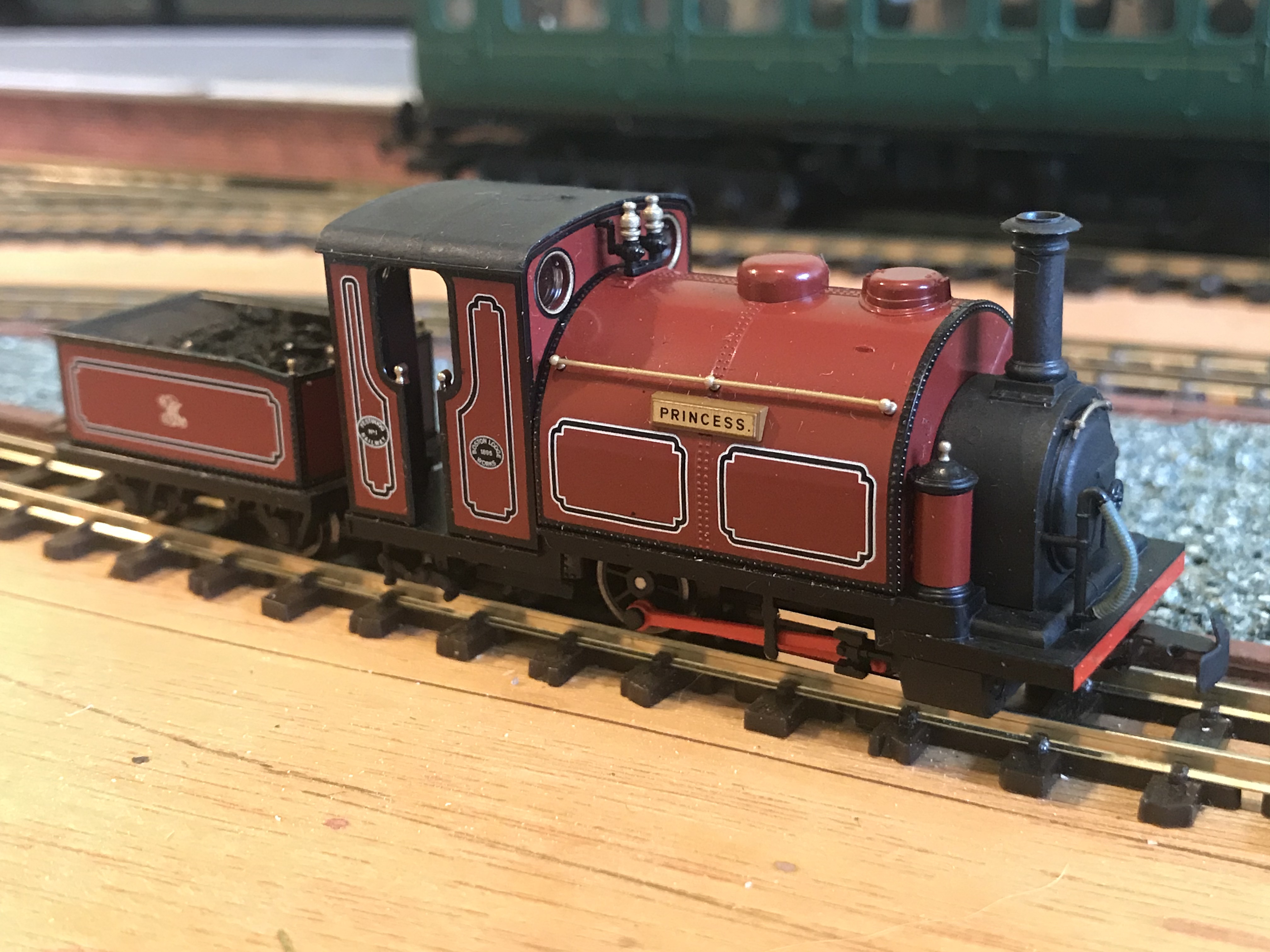
Princess has returned to the test track from Himself's where it had been sent for the application of a little subtlety.


As it comes out of the box the Kato / Peco England has a number of things which betray that it was produced to a price - or for a certain aspiration of specification -  but these can be easily attended to.

Among the things Himself has done is apply some black paint to the upright at the end of the slidebars, which stands out like a sore thumb in silver.

A brush over with matt varnish makes the smokebox look like a loco that's had a fire in it, and the cab roof looks an awful lot better when it's not black and shiny.

It's also had the happy effect, to my eyes, of making the chimney look a bit fatter and much more prototypical.

The vac pipe bags look a lot more realistic when they are no longer black plastic colour.

The last thing he's done, which you might not notice until I point it out, but is one of those things you can't unsee once you've spotted it, is to run some black paint around the edges of the cab opening,

The livery finish on these models is really very good, but they are badly let down that in places like the cab doorway the black edging is only on the sides and doesn't extend to the edges which remain shiny, maroon-coloured plastic.

It really stood out when you looked at the engine in 3/4 view.

It's such a small thing but it makes such a difference when you fix it,


Sunday, 27 March 2022

(Not) Ready To Run

It wouldn't surprise me if Peco's PR people are a little frustrated this weekend.

(And if they're not, then they ought to be.)

For days my social media feeds have been full of excited narrow gauge modellers receiving their England engines, but as the week wore on the pictures changed from delighted owners posing their new pride and joys on their layouts, to disappointed customers posting images of their purchases arriving in various states of distress and disassembly.

And then our one turned up.


Our Princess had been ordered by a customer as a thank you for a model I'm making for them, and I opened the parcel fearing the worst when I saw how it had been dispatched in an over-size cardboard box with plenty of rattling-around room, even with the protection of bubble wrap.

As you can see, a certain amount of owner reassembly was required - which is putting it mildly!

The cab was detached (which seems to be the most common complaint) and the tender and engine had moved around so much they had become decoupled.

Lifting it from the - obviously inadequate - polystyrene tray I discovered the whistles had also fallen off.

Fortunately the pins securing the coupling rods remained in place - others have not been so lucky.

Perhaps because of decades handling white metal and etched brass locos it's alarming how flimsy and delicate these 009 RTR locos feel - not just this England - and there is genuine trepidation when attempting to re-fit the displaced parts that you're going to further damage the model while handling it.

Fitting the extra knobs which come in the pack, on the sand pots and the front of the tender, can be quite tricky too.

It's a clever design with the plastic sprues which break off once you've inserted the details, but as I found to my cost, if you don't push them in perfectly perpendicular then they can snap off in the wrong place.

I had two which did this and had to be very carefully drilled out,

It's lucky they provide spares.

Now all that's been done I can get on with trying it out on the test track before passing it over for Himself to have a play about with.

One last thought is about opinions I've seen on some social media groups that owners should now cease posting pictures or comments about the state that their models have arrived in, and that we should just be grateful that they've been produced in the first place.

I have to respectfully disagree.

It's not for the consumer to be grateful for any commercial product, let alone one in which a substantial number arrive severely damaged because of packaging which, on the face of it, is not up to the job.

Retailers are replacing them without any quibbles, as far as I can tell, which is as it should be and very good to see.

But there's no getting away from the fact it really shouldn't have happened in the first place.

Monday, 28 February 2022

England In Scotland

Model Rail Scotland returned at the weekend after a two year pandemic-enforced break, and it brought home to me how 4mm narrow gauge modelling has burst into the mainstream while we've been away.

On trade stands of the 'box shifters' around the giant exhibtion hall in the SEC I kept coming across Bachmann Double Fairlies among all the 00 and N gauge products, and of course the latest version of 'Merddin Emrys' was prominent on the company's own display along with the unpainted samples of the Quarry Hunslets.

The Peco stand, naturally, featured the Small England which we are expecting in the shops imminently.

While a senior figure from Peco was admiring Bron Hebog during the show I remarked to him that they were more than welcome to liberate one of those samples from their display case and bring it over to the layout to show it in an authentic setting.

This was something Accurascale were doing with their brand new Class 55 Deltic models, depositing them on a number of the 00 layouts around the show, which seemed like a pretty smart marketing move to me.

Towards the end of the Sunday (when there were barely any visitors left in the hall.....) the man from Peco returned holding a model of Prince, and so for the first time we - and they - got to see how it performs 'in the wild'.

And the verdict is that I was impressed.

And I'll admit I was wrong to scoff at those traction tyres.

The Bachman Fairlie struggled in the back-to-back test against our Backwoods brass models - as you would expect - but the hard truth is that even with our lightest, styrene-built, carriages it can't pull a prototypical load for a Fairlie up the bank on Bron Hebog.

We hooked the Peco England onto our Victorian set, which includes three brass bogie carriages - a load which would test the Bachmann Fairlie to the limit - and it strolled up the grade with no hint of slip.

Not only that, but it ran very smoothly.  

There was no hint of a stutter on any points or board joints, and it was very controllable.

This was very pleasing because my previous experience of using Kato power, in our KMX Tamper and the Parry People Mover, is that they are very flighty and hard to control, and geared much too high.

It's also been our experience so far running the Bachmann locomotives, that although they run beautifully smoothly they are very sensitive to gradient.

They slow as soon as they start up a hill and are liable to run away on descent unless you are quick to throttle back.

One of the - justifiable - criticisms of the Peco product is that it is not DCC ready out of the box, you will need to get your soldering iron out and re-engineer the model yourself.   

In terms of how it looks, the finish is very shiny, and I would want to calm it down with a satin varnish, for sure.

And there are still those other things that disappoint, like the slide bars which are nothing at all like the prototype, and having a one-size-fits-all nameplate moulding on the tanks which stands out a mile on the Prince version.

So a big thumbs up for the chassis, but I wish they'd just tried a little harder on the body and not settled for the compromises that have been made.

And I still don't know what they were thinking of showing off those dreadful engineering prototypes a few years ago - some things are best left behind closed doors.


Sunday, 19 December 2021

Big Meets Small

Tracklaying on the narrow gauge side of the 'test track' has continued apace this weekend, and already I'm getting a glimpse of the 'Blaenau Central' effect I was after.

I 've read many articles about the very creative track plans people have come up with for small spaces, but this is unashamedly a traditional oval, planned to function as a 'train set' for my youngest, partially justified by having somewhere to test the running of my NG models, which until now have always had to be dispatched to Himself for proving runs.

So on the NG side we're going to have a simple island platform with a long turnback / storage siding (at the bottom end of the picture) and at the other end a point leading off into a separate shed area alongside the standard gauge steam MPD. 

At the top right, just after the track swings past the goods yard weigh house, there is another point into a short transfer siding where the standard gauge coal wagons can discharge their load into NG wagons waiting below.

My first experience laying 009 track has been fun.

The fishplate joiners for the smaller code rail are much more fiddly to handle that the Code 100 stuff - and even I've had to squint a little at times - but I found I soon got used to it, and some test passes with the half-built Worsley bowsider on Dundas FR bogies suggests all is well so far.


Monday, 25 October 2021

I'm Sorry, I Model 009

Recently I find myself bemused by the self-censorship being shown by what we'll call the 009 community online towards manufacturers in commenting on their new products, and intrigued by why this should be so?

Bemused, because I'm struggling - off the top of my head - to think of any other area where, as consumers, we encourage each other to keep our opinions to ourselves and be grateful for what we get.

You probably won't be surprised to read that the source of this disquiet is the forthcoming Peco / Kato England engine, where those who have put fingers to keyboard with observations (not complaints!) about the good and no-so-good aspects we can see in the samples have been dismissed as critics, whingers, nit-pickers and rivet-counters.

That's pretty standard fare for model forums, and I would suggest the debate on this product has been far more measured than I've seen when the subject has been 3D printing or the profusion of steam locomotives with tram chassis.

And yet in recent days I have seen two major threads deleted because moderators have clearly decided (without explaining why) that these discussions need to be closed down.

There were a number of people posting - before their words were expunged from the record - who seemed to believe there was a risk that somehow all this chatter would upset the manufacturers, and frighten them off from continuing their investment in ready-to-run 4mm narrow gauge after decades where there were no British outline products on offer.

I do believe that's a rather naive view.

These are commercial organisations. They make and market products because - and only because - they believe they will get a return on their investment.

They are not doing us a favour by moving into 009.

If they were doing it out of benevolence it would surely have happened before now.

No, they're doing it because they've stumbled across an untapped market, and they're all racing to grab the biggest share.

Think of model railways like a slate mine. (Very narrow gauge.)

They've been quarrying 00 for all it's worth for decades, but the vein is becoming thinner and the walls between the chambers are down to their minimum thickness.

They're scrabbling around looking for increasingly obscure prototypes - indeed, these days we see them releasing prototype, one-off locomotives - and there are new competitors trying to grab a share of their market.

So in 009 they've found a new, unquarried hill, and they're tunnelling in from all sides staking their claim.

Do you really think they're going abandon the workings because of vigorous appraisal of their new products online?

(I'll drop the slate metaphor now, you'll be relieved to know.)

A lot of old sayings have a lot of truth to them, and one of them is: there's no such thing as bad publicity.

If you're bringing out a new product the one thing you want most - other than sales - is for people to be talking about it, especially if you're aiming to expand what its currently a small market.

I don't believe manufacturers would be put off by their product becoming the burning topic on a forum or a Facebook page, I suspect they're probably delighted.

And if it happens some of that feedback is negative, or pointing out shortcomings, the wisest thing is to consider it part of your market research, especially if it's your first product.

I've written many times here that I'm ecstatic to see manufacturers discover 009, and the more the merrier,

But I also don't see why any of us should make any apologies for expecting these models are the best they can be, and match the standards of detail, performance and specification that is offered in other scales.

These are not bargain basement products.

We are being invited to spend three figure sums investing in these products, so it's not unreasonable of us to expect the best, and to comment on whether we believe we're getting it or not.

I don't see any of these manufacturers withdrawing after a critical magazine review, so why should the actual potential customers feel the need to self-censor?


Wednesday, 13 October 2021

Englands Glory?

The appearance last week of images of decorated samples of the Peco / Kato FR England models has been greeted with almost universal acclaim in the online 009 community, so I suspect I am not going to make myself very popular by giving a more nuanced appraisal of what we've been shown.

Like everyone I am overjoyed to see the appearance of a ready-to-run model of my all-time favourite narrow gauge engines, and I have no doubt at all that these will be a terrific commercial success.

They look to be night and day by comparison to anything that has been possible with the many kits produced over the decades, and for that the designers and manufacturers are to be congratulated.

As far as can be seen from these images the finish looks to be superb, and there's no doubt they have captured the look and feel of these iconic FR locos, and I am very pleased indeed to see the very distinctive Small England wheels have been replicated, and the motion - although apparently not to the fish belly profile - looks suitably slender.

The lining looks crisp and the rivet detailing delightful.

Do you sense I'm building up to a but?

You're right, and more than one.

Judging from these pictures I'm left with a nagging feeling of frustration of what might have been if the makers had gone the whole way and striven to make the most accurate representations of the individual locomotives rather than compromise on a generic tooling.

Let's face it, if there's just one thing readers of this blog must have realised by now it is that identical' is not a word in the FR lexicon!

To begin with let's look at the most obvious example on this pair: the nameplate on Prince.

It's the same length as the one on Princess.

Since when? 

Anyone who has cast even the most cursory glance at the real locomotives, or any photos of them, surely cannot miss that the plate (and mounting block) on Prince is so obviously shorter.

I'm sorry if this seems harsh, but when they've gone to the effort of fitting different smokebox handrails on the two models to not find a way to alter the nameplates is a poor show.

The slidebars and the mounting bracket also look a little toy-like from this distance - a bit too much like what we've got on the ancient Ibertren chassis under our existing Langley white metal kits.

Other reviewers have picked up on the whistles and the lining around the rear of the cab.

These may seem like trivial complaints, especially in the context of the decades we have waited for manufacturers to discover 009, but the reality is that now that they have these compromises on models such as these are not where the rest of the market is.

(They'll still fly off the shelves, though...)

When this project was announced there was great anticipation of the Kato chassis, but I see now this model will be fitted with a traction tyre - is this the 1980s? - and I have seen conflicting reports about whether or not it will be DCC ready or even DCC compatible?

Let's not pretend that it's because the model is too small.  Bachmann have found a way to make room for decoders in their Quarry Hunslets which are tiny compared to the capacious saddle tanks on an England.

That won't affect whether or not we'll buy some - we surely will - because our layouts are DC, but some of the translated literature suggests the prototypes have hauled 3 (!) Peco carriages on level track, even with their rubber tyres.

That's a little worrying if, like us, you have a layout with gradients. Hopefully something was lost in translation there.

Ultimately, I know what is at the route of my comparative disappointment at this model.

It was an open secret that another manufacturer was intending to make 4mm models of these locomotives - indeed, had gone so far as to measure them up - and it would appear that these models were announced as a spoiler.

Well, I guess all's fair in love, war and business, but I believe what we have ended up with, in this very pretty, slightly generic England, is a far cry from what we were likely to get (eventually) if the other firm had been left to it.

And that's a shame.


Monday, 23 August 2021

Learning Curves

Due to popular demand - well, a couple of comments, anyway - I thought I would post an update on the 'test track' project.

The standard gauge part is now almost complete as far as tracklaying is concerned, but there is no juice connected to any of it yet.

Despite being to all intents and purposes a 'train set' with the design of the tracks we've tried to make it to a reasonably high standard using flexitrack and medium/long radius, electrofrog points, and despite appearances none of the curves are any tighter than set track radius 2 at any point.

It's been a great learning curve for me because it's the first time I've laid track.

We began with a day-long session with Himself as the tutor, when we got most of the station area completed, and I've been taking it on from there solo, with occasional remote assistance by phone message - remind me how many insulated joiners this point needs again??

It's been a very enjoyable, and completely absorbing, process, although I can't pretend that it's always gone right first time.

Quite often on the large curves I've stood back to admire my handiwork, or pushed a carriage along to check clearances, only to decide that I could do better and pull it up and try again.

As I have written previously, this will be a dual gauge set up, and although the narrow gauge element was included for the purposes of having a test track at home, I've not been able to resist attempting to justify its existence.

Therefore, at one end of the goods yard there is a raised siding where I intend to create a coal transhipment point from standard to narrow gauge.

Image in Peter Johnson's Vale of Rheidol book published by Pen and Sword

I envisage something which is a blend of the arrangements on the Vale of Rheidol (above) but including chutes in the style of Minffordd Yard.

Picture by Rob Fisher, on Fesitpedia.org.uk

Quite what narrow gauge rolling stock will need to be 'tested' is as yet unclear.

Saturday, 2 January 2021

Happy New Year - Start Saving!

Best wishes for 2021 to everyone who clicks in to read this blog! I wonder what this year will bring?

I predict it's going to be a very significant one for 009 narrow gauge modelling.

We know of at least one new locomotive (the Heljan Lyn) which is about to be released, and a couple of exciting projects in development (the Peco/Kato England engine and a VofR tank commissioned by Model Rail) and I wouldn't be surprised if there is not more announcements by the end of year.

2021 could get very expensive!

Himself has been trying out our second RTR item having received a Peco first class bug box in Victorian livery for Christmas.


First impressions are very good!

It looks at home running as part of our Victorian train with our kit built, brass stock.

Direct comparison with our fleet of 'Small Birminghams' from the Chris Veitch range show the Peco carriage is slightly longer and the lower body slightly deeper.


The FR monograms on this carriage look as if they might be a little on the large side when comparing with photographs.

The livery detail is very crisp and far better than we could replicate ourselves, but being made of plastic it could perhaps do with a little more weight, especially if it's going be positioned at the head of a string of brass carriages.

I suspect Himself will also look at replacing the plastic wheelsets with something with metal tyres.

If more are produced depicting the contemporary FR fleet - for example the 3rd class carriages fully glazed rather than with side panels - I've no doubt we'll see more of them join our fleet.

This model bodes well for the FR bowsider that Peco will be producing.  

See what I mean about 2021 being expensive??


Monday, 25 November 2019

A Missed Opportunity

I wasn't able to get to the Warley exhibition at the NEC at the weekend, but I sent a spy in the form of Himself to report back for me.

It pains me to say that I was very disappointed with what I've seen so far of the prototype for the Peco/Kato England engines, which I had been so looking forward to.

I don't know whether it's the case that the early sample they showed is very misrepresentative of what the finished product will look like, or whether this is not going to be what I had hoped for.


I can overlook a rough 3D print on the body but I can't deny I'm worried by what's underneath it.

I'm told it's temporarily mounted on a Kato N gauge loco chassis, but the question is whether this is indicative of the quality of the mechanism we're going to get?

Look at the way the piston pokes out of the front of the cylinder.

See how crude the crosshead and the slidebars are.

Is this what we are to expect in the finished product?

The one thing that is really going to make of break this model for me is going to be the chassis.

When you look at a Small England the really distinctive features are those little wagon wheels with very few spokes, and the slender, round-profile motion.


That is what I really want to see from this model.

England engine bodies have been around for more than 60 years in both white metal and now 3D printers.

We don't need a big manufacturer to produce them, it's a decent chassis for them which we've been crying out for.

But after this weekend I have to confess I've got the fear that Kato could let us down.

Look at what else was on their stand.

Are they in the business of selling models or toys?


You'll also spot a very early stage of a Double Fairlie body in there among the dinosaur wagons and the rocket contraptions.

Observe also the ridiculously tight radius of the circle of track the grey England is sitting on and the yawning chasm between the locomotive and the tender.

I notice that the first question that appears in online forums about new RTR OO9 locos is what radius curves they will go around (sigh) and again I fear this engine is being designed with rabbit warrens in mind rather than serious modellers.

I do hope I'm wrong, I really do.

The name of the game in model railway retailing these days is pre-ordering, which is why the manufacturers are so keen to show off samples to generate advanced sales.

Except in this case all the Peco / Kato sample has achieved is made me want to hold off until I can be more certain about what precisely I will be getting for my money.

A missed opportunity indeed.

Saturday, 3 August 2019

Double Trouble?

I think the time has come for one of my occasional Op Ed pieces where I pass comment on matters in the real or model railway world.

(Pauses to reach for flak jacket and tin hat...)

One week on, I don't suppose there are many narrow gauge modellers who haven't heard of the announcement of the PECO / Kato collaboration to produce ready to run OO9 models of the FR's iconic 'Small England' and Double Fairlie locomotives.


It's provoked the predictable rows on social media, either about the cost or the fear that it will spell the end of the scale as we know it - both of which I regard as bunkum.

What I find fascinating about this development is what it says about the state of the model railway industry.

I wasn't surprised in the slightest about an announcement of RTR models of these prototypes -  what astonished me was where it came from.

You see, I've known a long while that another manufacturer has been intending to produce models of these engines - indeed, had begun work on the project - and they must be kicking themselves that they've allowed themselves to be scooped.

I've got no experience in the model railway trade but it seems to me that they have two options: to junk the work and the investment they've made in the project, or reveal their hand and try to stifle the PECO/Kato project at birth.

I wonder what they'll decide to do?

I can't help thinking that this manufacturer has been rather caught napping and left itself  exposed.

The success of Bachmann's Baldwin, and orders for the Quarry Hunslet, and Heljan's perseverance with the troubled L and B tanks, has shown that there's a market for OO9 ready to be exploited.

It was always inevitable that someone would produce FR Fairlies and Englands because, like them or not, they are the iconic narrow gauge engines.

If you were inventing OO as a scale the first model you would make, if you wanted to shift a barrow load, would be Flying Scotsman, and Fairlies are the Narrow Gauge answer to Scotsman - almost everyone's heard of them.

This scenario reminds me a little of the recent James May TV documentary on Hornby, where the new management pulled a fast one on the enterprising retailer Rails of Sheffield by producing a model of the 'Terrier' tanks when they knew the shop had launched a project to bring their own to market.

I've heard that in recent years there was a lot of unhappiness among standard gauge modellers about manufacturers announcing intended new models many years ahead of the date when they might hit the shelves.

There can be long lead times on these projects and now the industry has rowed back a little in response, announcing only what they intend to deliver within the next year to 18 months.

It will be fascinating to see what effect this PECO/Kato move will have.

For PECO I think it's a very smart move. These engines will undoubtedly attract new people into OO9, for which they will need to buy lots of track.....

That's what you call a win-win.

I wonder if it will galvanise their rival manufacturers to up the tempo of expanding their OO9 ranges, or retreat with their fingers burnt?

I very much hope not it's not the latter.


Saturday, 20 July 2019

From The Archives

I got a very pleasant surprise a couple of weeks ago when one of the luminaries of PECO Publications told me that they’d dug out the pictures of Dduallt taken a quarter of a century ago to use in the latest of their special editions.


This magazine is the latest in the series and is all about modelling the preserved railway scene, which is something I’ve been involved with since I was a a schoolboy, and which is very much overlooked.


The images, shot by the legendary Len Weal after hours at one of our early exhibitions, are historic in their own right in that they feature much of our first generation of rolling stock, much of which has been retired, sold or, in the case of the Langley Merddin Emrys given away as a gift to a former FR luminary.

Have the years been kind?

Why not buy a copy of the magazine and let us know?

Wednesday, 6 March 2019

Quarryman’s Train

Among the interesting things to see at Model Rail Scotland recently were these samples of PECO's next OO9 products.


I'm delighted to see another FR product being launched on the market and I've always had a soft spot for these very basic carriages, and their brake van variants.

I could be tempted by a model of Van 2 in its green livery myself.

Our only model is one kit-bashed from the Dundas kit in the distinctly orange colour it sported at the end of the 1980s, so by now it's rather outdated with a lot of our other stock.

I do feel a little bad for Dundas who will inevitably see a decline in sales of what is a very good, and easily put together kit which has served the hobby well.

Models like this feed the narrative of some critics who argue that ready to run is bad for the hobby.

I prefer to believe that the entry of the likes of PECO and Bachmann will have the effect of expanding the market for narrow gauge, bringing new modellers into the scale.

Hopefully those people will progress to expanding their rolling stock from kits, thus making up for any impact on a couple of product lines.

Friday, 14 December 2018

Customer Service

The old adage goes that the customer is always right, even when they're wrong.

When I'm building models to order I always do my best to try to meet my clients requirements, even when it sometimes makes things a little more awkward.

Take the case of the couplings on the latest batch of wagons which are just about finished.

The customer has standardised on couplings designed by PECO for their ready to run range of rolling stock..

Standardising in this way makes things much easier  - but fixing plastic parts to brass? Not so much...


The etched bogie frames I use on my kits work best with the brass Greenwich couplings, which can be soldered direct onto the tongue which extends out from the middle.  Or failing that the Bemo ones with a long shaft which gives you plenty of surface area to glue them on.

These PECO couplings are designed to slot into NEM pockets, and have almost no shaft on them.

They're also made from the kind of plastic which doesn't work with Superglue.

So the solution I've had to adopt is, firstly, to solder on a brass extension piece onto the bogie, and then use epoxy resin to attach the coupling, which is less than ideal because it takes an age even for the rapid stuff to set hard.

It's done, however, so now all I have to do is fix on the resin detail parts on the side of the bogies (it seemed sensible to wait until I'd finished the soldering work) and then spray them.


Friday, 28 October 2016

Oh Oh!

I posted last week about my fears that Himself was about to be distracted from the narrow gauge project by his grandson (aka The Trainee) and my prophesy has come to pass even sooner than I had expected.

I suspect Himself may already be regretting his innocent suggestion of taking The Trainee along to the local exhibition last weekend.

No sooner had we entered the venue that The Trainee zeroed-in like a cruise missile on a box of old OO track being sold off behind one of the trade stands.

Anyone who has ever had dealings with a 3 and a half year old will appreciate that from that fateful moment there was no way that Himself was going to be allowed to leave empty handed.


He is now the proud owner of 10 yards of finest concrete sleeper PECO Streamline which The Trainee is expecting to be transformed into a basic train set by his next visit.

(You can take it from me that Himself's life won't be worth living if it's not! The Trainee will see to that.)

Incidentally, I suspect the choice of concrete sleepers was a deliberate move - he's no doubt anticipating high speed running!

Thursday, 9 July 2015

Extended Sidings

By discreetly squirrelling away some of his meagre pension into a secret slush fund Himself has saved sufficient pennies to buy some more point motors to complete the top layer of the extended fiddle yards.

This shot shows quite dramatically how we are going to be running either very long or very short trains on Bron Hebog


The long lines will be able to handle a 10 car modern WHR rake while the smaller ones on the left will be used for works trains or heritage rakes so only need to be long enough for an asthmatic England engine and a couple of bowsiders.

With such a stark division in the length of the roads the onus is going to be on the operators to ensure they match the trains dispatched from either end with capacity at the other terminal.

It would be dreadful thing if your opposite number was suddenly faced with an incoming double-headed Garrett consist with no where to put it.

I'm sure it would never happen on purpose.....

Monday, 26 January 2015

Tongue Tied

I've been building a trio of SAR wagons for a client who wanted them ready to run complete with couplings.

On his layout he's fitting all his stock with the new coupling PECO has developed for its L&B coaches and wagons which are designed to locate in a NEM pocket.

The task for me was to work out how to fit them to my resin wagons / brass bogies and get them set at the correct height.

My bogie design has a brass tongue which extends from the stretcher and, on our rolling stock, this is where we solder on the long shaft of the brass, fold-up Greenwich couplings which we are now fitting as standard on Bron Hebog.

It works well too with the old Bemo couplings which have a long plastic shaft which can be glued on.

The PECO ones, however, have a very short shaft because they're designed to clip into the pockets and a test run gluing one of them onto the end of the brass tongue on my bogies showed it was a whisker too short and there wasn't quite enough clearance for the coupling loop to rise as high as I'd like.

So what I've decided to do is solder a small extension onto the tongue using some offcuts from old brass frets - yet again proving the value of being canny about what you throw away.


My customer also sent me a PECO RTR wagon to enable me to set the coupling heights properly.

As lucky would have it the brass tongue is in almost exactly the right position and can be easily bent up or down a bit as required.


And here is is with one of the B wagons sitting on its bogies.


There's nothing like the satisfaction of a successful adaptation.