Monday, 14 April 2014

Undercoat

I've begun the process of painting the three Super Barns I'm building for a client.

Here's one of them in a coat of red primer.


This is the colour I spray the South African wagons with but I've never used it on carriages before having always gone for a grey.

Given that I have three carriages to finish I'm hoping to reduce the labour time by spraying one of the colours on - the cream - which should be easier and faster than doing so by hand because it's awful fiddly getting it around all those little window frames along the top and it usually takes at least two if not three coats.

My hope is that even with a dark red base the cream from the can will go on a little faster and the red, which I will apply by hand, should be helped by this undercoat colour.


Saturday, 12 April 2014

On Location

Remember the house I was building for Bron Hebog a few weeks ago? Well it's back and getting a trial run in position on the layout.


For anyone not familiar with the Oberon Wood estate and unsure of where this house fits in this aerial view should help.


Beddgelert station platform is away to the bottom right of the shot and the cutting leads to Goat Tunnel towards the top left.

The other two houses I built last year have been entrusted to the Artistic Director who is believed to be painting them.

Such statements can never be made definitively until one sees irrefutable evidence, but when I do let me assure you you'll be the first to know.

Thursday, 10 April 2014

One Last Job

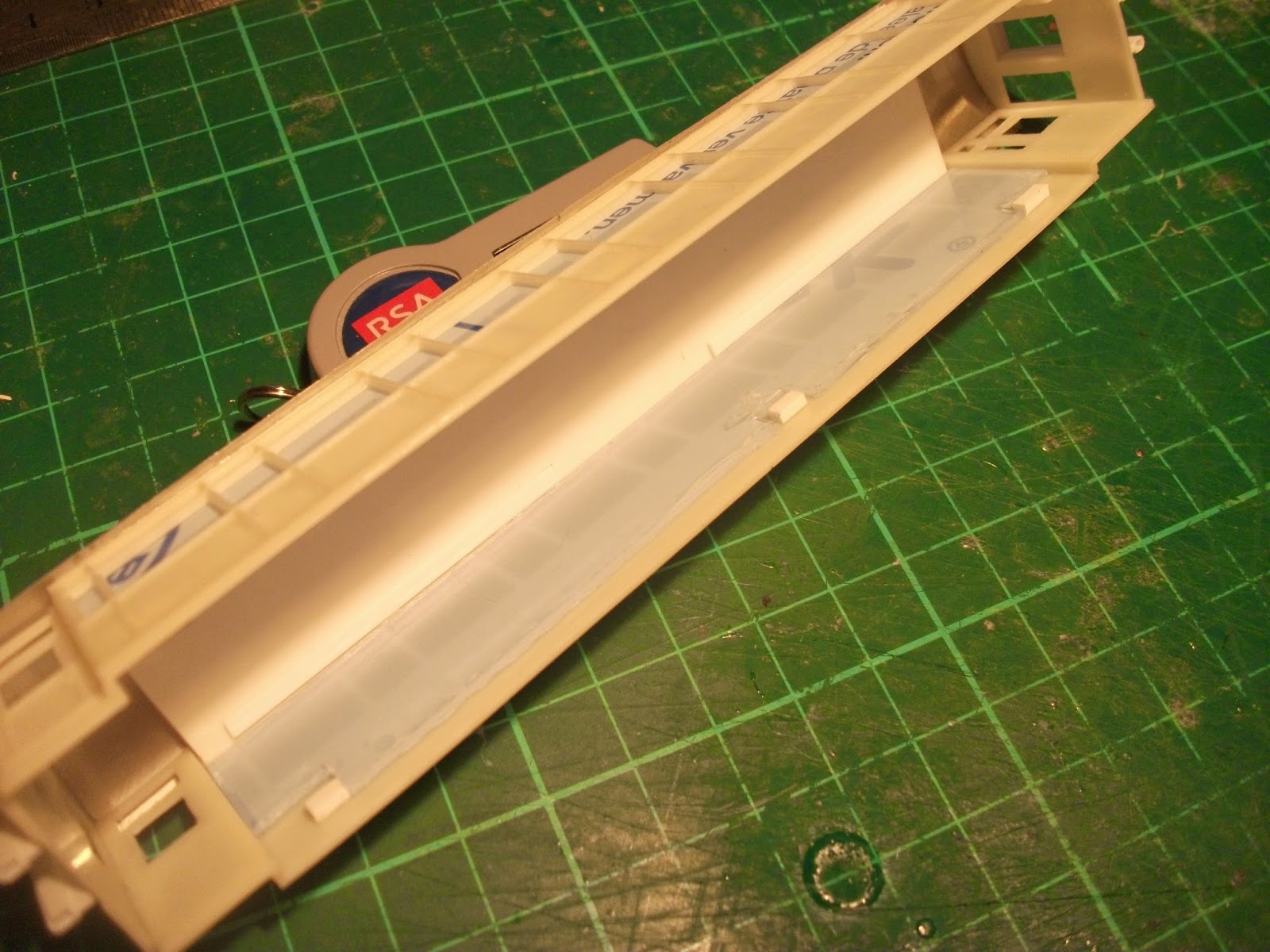
I'd almost forgotten one very important job before I begin painting the Super Barns - fitting the glazing.

It's not essential to do it at this stage but it does involve quite a bit of handling so it probably makes more sense to get it out of the way now.


I generally cut this from a perspex sheet 20" thick which has a protective film on both sides which you don't remove until the final fitment. That explains the blue tint to what you can see above.

I thought you might also like to see exactly how we fit glazing in our carriages.

We try to avoid gluing them into position if we possibly can relying on the interior and strips hidden beneath the roof, to hold it in place.


The little white squares of styrene are the stop blocks which prevent the floor / chassis disappearing up inside the body and set the correct ride height for the carriage and so I have to cut out sections from the glazing to fit around them.

The glazing for the vestibules and ends will have to be secured in place with a spot of glue but as they're much smaller than the main runs they're easier to manipulate and, I hope, there's less chance of accidentally getting some solvent smeared on the wrong bit when fitting them.

Tuesday, 8 April 2014

Before & After

Alas the job of ballasting doesn't end when you walk away and leave the watered-down glue to set the stones in to position,

If you want a neat job you have to return to the scene of the crime to remove all the stray ones sitting on top of the sleepers and more importantly any which are stuck to the web of the rail ready to derail the first passing train.

Close examination of these two snaps illustrate how much tidying up is involved.

And how it looked after Himself had been along dislodging stray stones.


So now the ballast bed stretches nearly all the way around the big bend.


The only section where the track is still bare is in the cutting and that won't be covered until we've got some rock stuck in place.

I'll have more on that for you in a couple of days time.

Sunday, 6 April 2014

Bonding Session

I got a bit ahead of myself last week when posting pictures of the new section of track being ballasted.

I forgot to mention that before the stones are spread onto the track there's the small job of soldering the feed wires in place.


Just in case you were wondering, this layout is being built according to the quaint old-fashioned concept that the operators actually control the trains themselves rather that leaving it to digital micro chips buried deep in the locomotives which probably have more computing power than the rocket that sent Man to the Moon.

As you can see Himself is doing a very neat job, which is not surprising since he is now fully training in wiring track of all sizes as you can see in this picture of him in action on the real FR.


I did briefly consider posting this snap on 1st April and seeing if anyone would believe me if I described it as a World Exclusive revelation that the FR is not a steam railway at all but a giant electric train set.

He is, in fact, drilling and bonding new track circuit wires into position, one of the many tasks that distract him in North Wales when he's supposed to be at home building the bloomin' layout!

Friday, 4 April 2014

Please Drink Responsibly

And what could be more responsible than recycling your beer can as part of a model?


Indeed, I have been even more responsible this time in that I have perfected my cutting technique so have have been able to get all 3 roofs out of around 2/3 of a can which I had left over from the first batch of Super Barns.

(Please note: this is no endorsement of a particular brand of pseudo-Belgian lager - the stuff we buy here is brewed in the UK - other beverages are available. You just have to ensure it's a pint sized can to get enough length for a Super Barn)

I have also refined the way I fit the roofs.

On the first batch I first glued the curved can section onto the flat styrene false ceiling before fixing this in place on the bodyshell.

Now having discovered how surprisingly rigid the thin can skin is I glued the flat false ceiling in place on the top of the carriage body first and then super-glued the metal on top.

I have also done without the strengthening piece of styrene along the spine of the roof.

I think they're about ready to paint now.


Wednesday, 2 April 2014

Ballasting

After the very rapid process of laying yards of track comes the much slower task of teasing tens of thousands of tiny stones into position.


The main tools required, as you can see, are a teaspoon, egg cup, paint brush, PVA glue and the vital drop of washing up liquid.

Oh, and a lot of patience!


Himself has done very well to ballast the full run of the board in the middle of the S bend.