Monday, 31 December 2012

Bron Hebog Review Of The Year

I know it's a bit of a cliche, but I thought some readers might enjoy taking a look back with me at the modelling activities of the Bron Hebog team over the last 12 months.

If nothing else it'll give you a reason to waste time when you're supposed to be working or, if you're on holiday, ignore those family members / relatives who you've spent a little too long in the company of over the increasingly elongated festive season.

January

2012 was a year when Bron Hebog re-emerged into the actual (as opposed to the virtual) gaze of the public, with two exhibition appearances booked, so January saw Himself braving the bitter chill of the workshop to crack on with scenic work on the front portion of the layout.

Goat Tunnel gained some genuinely rocky portals and liberal quantities of dyed carpet underlay were applied to the layout.


February

Himself continued working northwards, grassing over the Beddgelert station area.


Here at the Scottish end of the operation I was playing catch-up with the carriage works team at Blodge, continuing construction of my miniature version of the FR's latest Superbarn carriage 121, and helpfully pointing out to the team that their official plans for the carriage bore no relation to what they actually built....

March

There was no slackening of the pace as winter turned to spring.  Himself was now breaking new ground on Bron Hebog, building up scenery and trackbed on virgin baseboards. The Artistic Director was coerced into action once more to flutter his paintbrushes in the direction of the Cwm Cloch farmyard buildings I had made two years ago. The results - as we have come to expect - were stunning.


On my workbench I had started out on a project I'd been dreaming about for many years, scratch building a model of the WHR's infamously unsuccessful Parry People Mover.

April

And so to Sparsholt to show off what we'd achieved so far in front of the public and a knowledgeable audience of narrow gauge modellers.  The layout - or at least the one third of it we've built - ran pretty much faultlessly, no one demanded their money back so far as I know, and the huge Alsatian that was hiding under a trade stand in the corner of the room didn't eat us for lunch either. All in all as much as you could hope for from a day out, then.


May

A few weeks later we had to put ourselves out there in front of a much more critical audience - the punters at the Railex show in Aylesbury.  It's tough enough taking a narrow gauge layout to one of the big generalist shows - where the customers usually have eyes only for standard gauge or Thomas the Tank engine and little else in between - without your layout appearing to be an all-too-obvious work in progress.

The show saw the first running in turns for our Backwoods model of Linda, appearing in naked brass, and my model of the PPM also came out to play.


June

Our other veteran layout Dduallt had its chance in the spotlight, quite literally, as ace photographer Chirs Nevard trained his lens on it for a shoot for Model Rail magazine.


The previous month I had taken the plunge and bought a starter kit of resin casting materials to experiment with producing bits for some DZ wagons I wanted to make for Bron Hebog, a decision which was to have unforeseen commercial consequences.....

Himself completed his model of Linda in midnight blue livery. Nice!


July

It didn't take long from me first blogging about my intention to attempt to cast some DZ wagons in resin for folk to start asking if there was any chance I could run off some extra bits for them and before I knew it I found myself announcing that I would produce my very first kit.  What finally tipped me into it was an offer from the FR shop manager to buy a job lot and stock them among the narrow gauge modelling products in Porthmadog.

A few weeks later my first prototype broke cover.


August
The hot summer sun must have gone to my head (as unlikely as that seems given that I reside on the Clyde coast) because before the first DZ wagon kits had been produced I committed myself publicly to a follow-up kit for the NGY ballast wagons.
In another impulse move I invested some of my potential profits into one of Brian Madge's new kits for a cab-less Alice class Quarry Hunslet with the intention of using the outside frame chassis to revamp our ancient model of Britomart.


September

By this time I'm beginning to wonder what I might have started as orders poured in for the DZ kits almost as fast as the resin could be poured into the moulds. I posted a picture of the first dozen waiting to be bagged-up and dispatched.


October

While all that was going on in Scotland, at the southern end of the operation Himself had been busy with Britomart.  The original plan to graft the Madge chassis onto a Chivers body had to be abandoned and instead, with Brian's very generous assistance, he set about turning the cab-less kit into a fully enclosed engine.  I think it looks sensational.


November

Many months after the pictures were taken Dduallt finally appeared in the pages of Model Rail magazine.    

Progress on the ballast wagon kit was looking impressive although the reality was this was only the big, easy bits (the low-hanging fruit, as management types like to say) and there were still lots of fiddly, detailed bits to be designed, moulds made and test casts tried out.


December

We've rounded off the year with yet another media appearance,  Dduallt featured on nationwide TV - for all of 15 seconds - in a programme on BBC Four about the revival of the Welsh narrow gauge railways.  (Apparently borrowing our layout for an hour or so is cheaper than hiring a helicopter to get the same kind of shots - are we under-selling ourselves, I wonder?)


My range of kits continued to expand with an adapted DZ wagon kit - for the flat version of the wagons on the WHR - released as the start of the month and a start made on a kit for second generation type B wagons, due for release along with the NGY ballast wagons early in 2013.

So that was our modelling year.  Thank you so much for sharing it with us either virtually, here on the blog, or coming along to see us at exhibitions.

There are rumours that Bron Hebog may yet be going on tour in 2013 with an appearance mooted in the top left hand corner of Wales - when that's confirmed you'll read it first here.

All the best for 2013.


Saturday, 29 December 2012

B Good

Here, then, is a picture of the first assembled B wagon.


I've made this prototype one up in the guise of a WHR bike wagon with the intention of keeping it to use on Bron Hebog.

It still requires various bits adding to it, such as the numerous small handrails along the bottom of the frame, but what is shown here is 95% of what comes in the kit.

This one is sitting on a pair of DZ bogies for the purposes of the snap because the etches / castings for the Bettendorf bogies (which will also be supplied with the NGY ballast wagons) are still in the process of being designed.

Thursday, 27 December 2012

Santa Loves Narrow Gauge

He must do, because this is what I found under the tree on Xmas Day - a new cutting mat and a copy of Gordon Rushton's epic work recounting the story of the restoration of the WHR.


My old cutting mat was well overdue for replacement. Various accidents with solvent had left it not exactly flat anymore, which made cutting long straight lines rather difficult - unless extreme pressure was placed upon the piece you were cutting the line would often come out slightly curved. So a new one is very welcome.

The book is being slowly thumbed through. It is sumptuous in terms of text and illustrations. Indeed one might say it should be for the rather high price (£68) that the publisher has set.

But Gordon has a unique insight into the birth of the restoration project and has followed it very closely since and this thick volume is positively encyclopedic in the detail given of the historic, political and engineering aspects.

From my point of view, given the current projects I am working on, it is a shame there is no chapter devoted to the freight stock imported from South Africa, but there are plenty of pictures to peer into the corners of to discover hitherto unknown details.

I have to say that I have come across quite a few instances of typos and missing or duplicated words in my quick perusal of a few chapters, but if you read this blog regularly you'll find plenty of those here so people in glass houses etc..... (Although, of course, I'm not charging you £68 to read this...)

But let none of that distract from the fact it is a marvellous book and in my opinion anyone with an interest in the rebuilt WHR should be looking to buy one, even if they will have to save their pocket money first.

Sunday, 23 December 2012

Ramping It Up

I was right all along - and now I have proof!

When I began work on the B wagon kit a few weeks ago it was my intention to produce a kit which could be customised to portray these wagons fulfilling the various roles they have had on the WHR / FR as general freight carriers, coal transporters / storers and as bike wagons.

I was pretty sure in my own mind that one of these 'new style' wagons was once employed as a bike carrier but I couldn't find any proof of that through sources such as the official stock book or the Festipedia wiki.

Fortunately Himself has come up with the goods and provided me with the photographic evidence I wanted:


This was all I needed to press ahead with designing some alternative doors and ramps which means that, should they wish, customers will be able to buy a kit with the bits to build their own models of the WHR bike wagons.

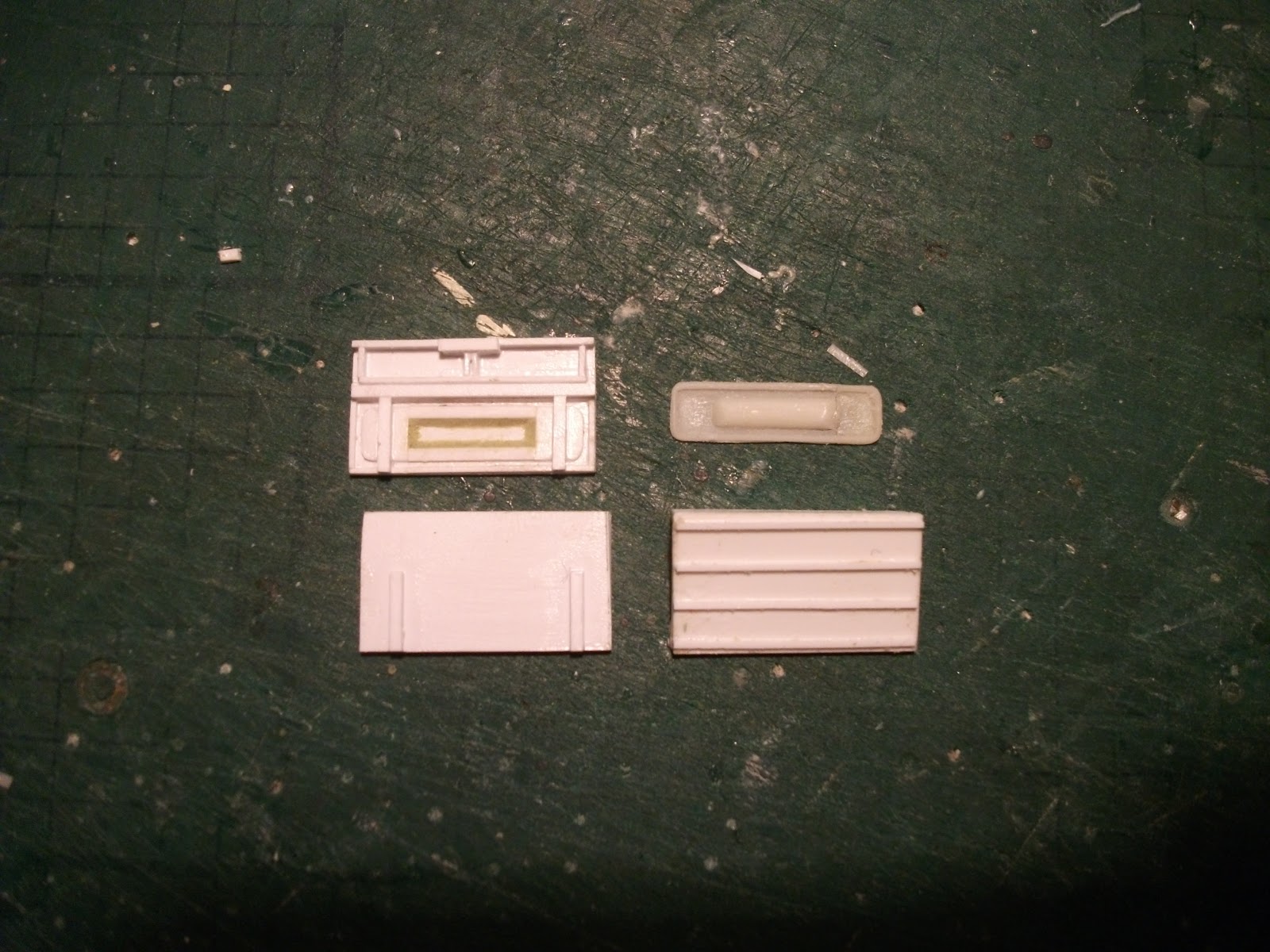
In this shot here you can compare the masters for the two styles of door.


I'm intending to build one of these as a second bike wagon for Bron Hebog, to run along with our old style version,  so even if there are no orders forthcoming for an alternative kit I won't have wasted my time and effort.

Friday, 21 December 2012

Spot On

This time the rivets are going on for real.

I've applied rows of resin transfers onto the masters for the NGY ballast wagon.

Fortunately there are not too many of them and they're in a relatively simple pattern along the bottom of the frame.


You can see that I've also had a play about with one of my spare DZ castings to see if it's realistic proposition to add them onto these wagons.

By contrast to the ballast wagon there are quite a lot of them in awkward places.

Fortunately I can report that they went on very easily (they really are very good, these rivet transfers) and so I shall press ahead with putting them onto my own fleet of DZ's for Bron Hebog

I think I will probably also stick some onto the masters for the DZ kit before I come to cast the third batch.

Wednesday, 19 December 2012

MOTW - 117

This carriage is now one of the older ones in our fleet, a fact given away by the rather huffed-up appearance of the windows.


It was probably one of the last carriages I built where the floor was fixed and the roof was left removable up until the point when the model had been painted, then the glazing was slipped in and the roof glued in place before the carriage received a final spray of varnish.

It is the varnish which frosted the windows which was the inescapable downside of building the carriages this way. Because we now build them with a floor which can be pulled out, and back in again, at will the glazing does not have to be inserted until after the model is varnished meaning the windows can remain impeccably transparent.

Our model shows 117 running in the push-pull set in the mid-1990s. 

It had recently had a comprehensive rebuild that saw all the pillars rearranged and reduced in number so the narrow, vertical drop down windows it was built with in 1977 were replaced with the bigger, bus-style, design with the sliding openings at the top.

This made the carriage look very much like 121, which was the last of the six 'tin carrs' built at Boston Lodge in the late 70s and early 80s, but inevitably the two were never identical.

In the fullness of time I will have to get around to making another 117 to run on Bron Hebog along with the rest of this set.  Running the green and ivory livery on the WHR would be stretching modeller's licence too far, methinks.