Showing posts with label Fiddle Yard. Show all posts

Wednesday, 22 April 2026

Secret Panels

Himself was thinking ahead and anticipating worst-case scenarios when he designed Minffordd, and he was careful to allow access in the event of a major failure or track relaying being required.


That's why there is a six-inch-long section of the narrow gauge lines at the Porthmadog end which can be lifted out to get at the Cambrian fiddle yard points hidden underneath.

At the moment he's investigating a curious fault with the route-setting function.

At each end of the Cambrian yard control panel is a rotary switch where the operator selects which road they require, press a single button, and a matrix of diodes and relays set the points accordingly.

During the Glasgow show we noticed when you had Road 1 selected, and wanted to change to Road 4 the 'king point'  - where roads 1-2 and 3-4 d split - would not move.

However, if you select Road 3 instead, the point will switch as it should, and you can then make a follow-up request for Road 4.


This explains a number of strange head-on collisions in the fiddle yard during the show which baffled the operators who were quite sure they had changed the points, and the LED indictor on the panel backed them up!

So one of the items on the snagging list to be tackled before the next appearance in Porthmadog is to find out what is causing this.

Removing this 'secret panel' makes it much easier to see what's going on under there and whether the point is being switched when it should be.


Monday, 20 April 2026

Yet Another Siding

Just as the scenic part of a layout is never finished it would appear that a fiddle yard certainly never is!

During the three-day show in Glasgow last month it became clear there was something lacking in the siding department on the narrow gauge side of Minffordd.

Spare freight stock for the yard shunting is kept on a standalone siding at the bottom end fiddle yard, which works in much the same way as the extension to the Mineral Line where you will often see a selection of FR wagons.

The trouble with just having a single siding is that if you wanted to get at the wagons at the far end you needed to lift off either them or everything else in the way in front of them.

We really should have given that more thought when we laid out the fiddle yard....

For the next show in Porthmadog Himself has invested in another set of points and laid a second siding, along with some uncoupling magnets.


Monday, 9 March 2026

Hoots Mon!

 There's juice loose about this hoose!

(OK, some of you may be too young to get the reference to the Wine Gums advert from the telly many decades ago.)

The pun is that Himself has decided that point motors are not what they used to be and decided to try fitting  some frog juicer units to improve the reliable switching of polarity on a couple of the key points in the fiddle yard on Minffordd.


Although the point blades went across OK we were relying on the switch on the motor unit to change the polarity on the frog, which was somethings a bit of a hit & miss affair.

This comes after a succession of failures in the fiddle yard on Bron Hebog where motors have failed on us, sometimes when the wire which moved the point blades has sheared, which is a really odd kind of failure.

We've keeping everything crossed that this will result in more reliable running for the show in Glasgow on a couple of weeks.

Wednesday, 4 March 2026

Tunnel Technology

"Tunnel collision is the worst to be feared, Sir".

So explained the title character in Charles Dickens' famous short ghost story 'The Signalman',  and everyone with a model railway knows that's just as true in miniature form!


The real Minffordd doesn't have a tunnel, of course, but we had to bend reality - in all senses - to make the Cambrian section of our layout into a complete circuit.

In the Porthmadog direction the line goes under a bridge, which is thereabouts in real life, but our train doesn't emerge on the other side.

Instead it sneaks beneath the narrow gauge ramp down into the exchange yard.

What adds to the complication is that while they are under cover the trains pass over the first of the points where the storage loops begin, indicated by the arrow on the photo below.


Now, modern RTR rolling stock runs pretty reliably and these days you don't get trains derailing routinely on turnouts.  

Except, of course, where there's human error and one of the operators changes a point while a train is going over it..........and then you're in a whole world of pain and embarrassment while you attempt to retrieve it in public.

So Himself has included a neat little piece of technology to try to prevent this as much as we can.

In the tunnel, opposite the point blades, is a light beam sensor which detects when a train is passing over the point, wired to an indicator on the control panel.

When there is a train passing in front of the sensor it breaks the beam and a corresponding LED on the control panel warns the operator not to move the switch.

I suppose it would be possible to also lash up a fail-safe so that when a train is detected power to the point motor is cut, but we haven't taken it that far.

Should all that fail, and we still somehow end up with a derailment under there, Himself has built-in an emergency access flap.

We've never had to use it.   

Yet.........


Friday, 27 February 2026

A Layout Makes Work For Idle Hands

I spent a very agreeable couple of hours yesterday afternoon indulging in a little test running with Himself on Minffordd.

I'd arranged to stop by and inspect the completed fiddle yard extensions, and get some images of the newly-fettled Wickham Trolley which I posted yesterday.

It's already clear the auxiliary fiddle yards for the OO Cambrian section are going to have a transformative effect on how we can run the layout at exhibitions.

We'll be able to run a better variety of trains and keep almost all the rolling stock in circulation, rather than swapping about what is on the tracks and what is kept aside.

The other big impact is that it potentially creates a job for another operator - a fifth!

Because of the layout of the existing yard, and the way the new terminal sidings branch off only the outer of the loops, one operator could be running a DMU or a short freight, or shunting the yard, while their colleague is busying themselves moving around locos which have been released by departing trains and moving them onto empty stock in the lines at the other side, for example.

Meanwhile there's capacity for another three operators to be engaged in running the FR half of the layout, one at each of the fiddle yards at either end, and another positioned at the front keeping something shunting about on the narrow gauge tracks in the yard.

Let's just hope we can find enough skilled and enthusiastic operators who are willing to come along and run it with us.

Sunday, 22 February 2026

Fiddle Yard Expansion

With more than a month to spare before our appearance at Model Rail Scotland the great news is that Himself has completed the project to expand the capacity of our OO Cambrian line fiddle yards on Minffordd.


During our first test exhibitions at the end of 2025 we discovered the limitations of the original design which showed how you can sometimes get 'railroaded' by sticking to your first concept and not seeing new opportunities as a project develops.

Initially I had imagined the Cambrian part of the layout would have a very limited range of rolling stock, perhaps just a couple of DMUs and a Class 24 with some goods wagons, in which case three or four short storage loops behind the backscene would be sufficient, because space was definitely at a premium.


As so often happens there was 'mission creep' during the build and we found ourselves acquiring more OO stock.  A Collett Goods here, a Standard Class 2 there, and, ooh, a Manor would be very Cambrian!

Soon enough we found ourselves wanting to run loco-hauled passenger trains and exhibitions became an exercise in juggling space and very careful parking of trains so they didn't foul the points at either end of the loops.

Over a few pints at night while were were away exhibiting Bron Hebog in Manchester just before Christmas one of our operating crew floated an idea of simple genius, inspired by the way he uses sidings on his layout as a surrogate fiddle yard to run trains effectively end-to-end on a loop-the-loop transit.

It dawned on us it was maybe possible to do something similar on Minffordd and more than double our capacity to store longer, loco-hauled trains.

I dubbed this project the 'Thompson Undertaking' in his honour!

As ever, it was up to Himself to work out how to turn these alcohol-induced brainwaves into practical solutions.

He identified there was space in front of the existing narrow gauge fiddle yards to add a thinner shelf below, and support it on a bracket fixed on the existing legs.


The big question was whether we were going to need to relay a lot of the existing fiddle yard loops in order to add some junction points.

We were in luck!  There was just enough space to squeeze in a Y-point, and the radius of the curves were a perfect match.


One compromise is that these extra points are hand-operated by switches and brass connecting rods, rather than being added into the rotary switch diode matrix which routes trains into the four main loops - that would just be too much extra work and head-scratching!

Something very similar was done at the other side and each line divides into two sidings which can each hold a loco and four carriages, or perhaps a long freight train, as you can see in the photo at the top of this post.

We can have three long trains on the layout with a spare road for one to terminate in after a trip around the circle.

We've also added an extra dead end storage road behind the loops which will give us even more options and hopefully mean we can keep nearly all our rolling stock on track and not have to keep lifting stuff on and off the rails to switch up the train formations.

Glasgow, next month, will be the big test!  Details in the Exhibition Diary.

Saturday, 3 February 2024

Minffordd Update: What's New in 2024

An update to this blog is severely overdue, it appears.   I hadn't realised it had been so long since I had last posted.

There's been no big leap forward since the autumn but there have been developments in a number of directions.

Rolling stock acquisition continues steadily.

The most recent arrivals are a suitably ragbag selection of carriages to represent the final few years of steam haulage on the Cambrian, made up of various ex-GWR designs from Collett and Hawksworth.

A Standard 3MT, with an authentic Machynlleth identity, has joined the fleet, along with one of the new Hornby 2-6-0 2MTs.

Both still require investment in sound chips and speakers, as does our 'Old Gent' Prince which is running-in on the home test track following surgery to straighten its frames to 1960s condition.

On the layout there's been a major rethink on the fiddle yard with a decision to ease the entry curve at the Harlech end, because it was slightly too tight for the steam engines and their pony trucks - it was fine when we had originally envisaged only running DMUs and Bo-Bo diesels.

This has necessitated the construction of a 4"-wide shelf extension - it's not ideal but needs must.

Underneath Himself has been getting on with the electrics, connecting up the point motors and the tracks for DCC operation.

I've been called into action to scratch the louvres into the glazing sheets on the 'Barns' to represent the iconic, but impractical, ventilation arrangements on these carriages.

Currently on my workbench is a shrunken representation of the Minffordd goods shed which is making good progress.

Finally, a plug for what its looking like our only exhibition appearance of 2024 as we prepare to take Dduallt to the SEC in Glasgow for the Model Rail Scotland show at the end of the month.

Do come and see us and say hello if you are able to visit the show.


Wednesday, 30 October 2019

What’s The Point?

Some running repairs have been required to the fiddle yards following our exhibition outing.


A couple of the points became a bit iffy over the weekend, needing repeated presses of the push buttons - and a burst from the CPU - to throw.

Another one had a freak failure of the shaft connecting the motor and the point.

All those dodgy units have now been replaced.


It’s remarkable that we should have so many fail in one weekend given how those installed on Dduallt have done nearly 30 years.

One of the rotary switches to select the roads has been changed - a big job with so many connections to be unsoldered and replaced - and there were a number of failed LEDS to be renewed.


Components are not what they used to be, it seems..

Saturday, 31 March 2018

Finding Faults

Himself is plugging away at the snagging list prior to taking Bron Hebog to Bressingham for Narrow Gauge East this summer.

The problem is that in trying to sort one issue you discover others.

So it was when he set up one half of the fiddle yards to try and sort an electrical niggle on the 'cab control' wiring and found that a number of the indicator LEDs on the Rhyd Ddu end panel had failed.


So he's had to open all that up to replace them.

Quite why they've failed is a mystery.

The ones in the control panel on Dduallt have lasted for more than 20 years, but after just two years in the west of Scotland climate these have gone pop!

Is there a connection?

Anyway, I thought you might also like to see a snap of the loco he's been using for testing duties.


Our original Dundas Linda, which had major surgery to its Ibertren chassis to fit it with cranks and outside frames (and a heart transplant with a Mashima motor) is still going strong.

Tuesday, 22 March 2016

Statement Of Intent

Himself appears to be serious about making a new fiddle yard / continuous run for Dduallt because he's invested in some wood.


There's none of your fancy-pants lightweight plywood construction around here - our base boards are virtually bomb-proof and built up on a solid foundation of best 2 x 1.

The nature of the challenge can be see in this photo of the back of the layout.


Until now the layout has operated with two independent yards with the upper one 7cm higher than the lower (Porthmadog) end and the whole assembly resembled a giant U shape.

What we're thinking at the moment is that we'll have a handful of loops which feed into the single track at either end.

According to my very basic calculations - and there's every chance these could be completely wrong - the gradient is 1 in 35 (7 cm gain in 250cm) which could prove interesting for Down trains which will have to climb back up the ramp again to get to the Blaenau end of the spiral!


Tuesday, 29 December 2015

ROTY - Part 2

Welcome to the second instalment in our review of the modelling year

May

Himself began a new project this month.


 For a long time I'd been intending to replace our models of the original FR bogie carriages 15 and 16 which I scratch built in styrene over 20 years ago and which were finished in late 1980's liveries and so really not suitable for running on Bron Hebog.

If these lovely Worsley Works etches had been available back in the 1990's then there is no way I would ever have attempted to scratch build such an intricate, panelled carriage myself!

This is number 16 which will be finished in the 1920's Colonel Stephens green livery.

Himself was also working on redesigning the fiddle yards on the layout with overlapping upper and lower yards to allow us to run full-length WHR trains.


June

I'd been working away on that row of houses for a few months and at last we had a row of three almost ready for painting.


I find I can get a little bored when working on one project solidly like this, so I decided to put the house building on hold once the 3rd one was complete and resumed work on the Garraway Set which had been on ice since the start of the year.

11 was assembled and a roof fitted before I began work on the interior.


July

It's becoming a familiar theme, but once again I gave myself a kick up the backside and resolved that the time had come to begin building a model that I'd been planning in my head for ages.

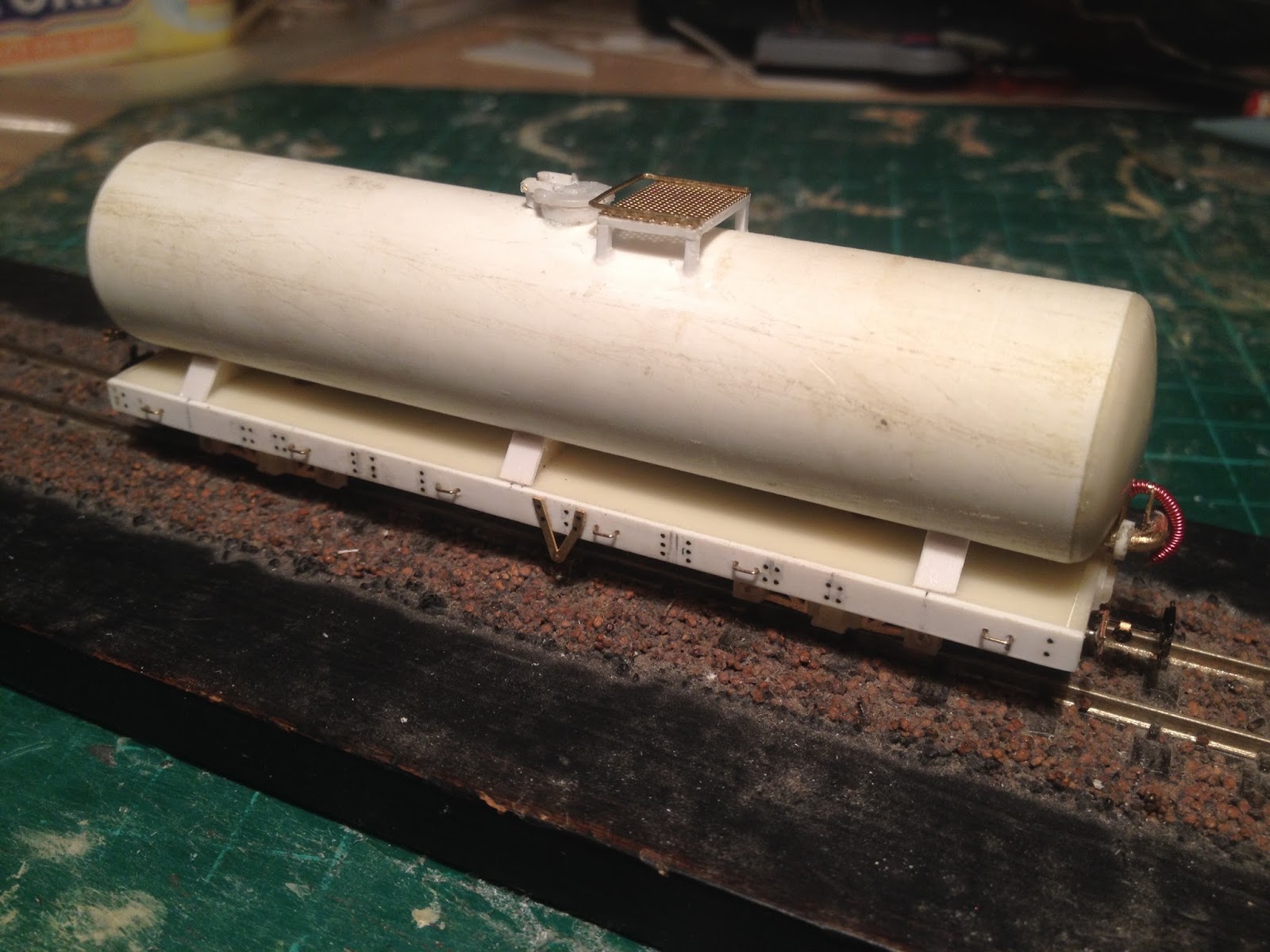
And so in the space of a few weeks I produced this model of the WHR water tank wagon which was built up on a DZ wagon chassis.


The tank, if you were wondering, was made with a length of 22mm plastic plumbing pipe.

The Artistic Director had one of his periodic bursts of activity and produced a mock-up of the Cwm Cloch farm house before finalising the design for me to build.

Here it is placed on the layout to check for fit and scaling.


August

Redesigning the fiddle yards was turning into quite a marathon project.

Himself spent making weeks wiring up these control panels at either end.


At the other end of the country I started work on building the farm house with the intention that even if it would not be finished we would at least have something presentable to place in the space for the big event of the year which was coming in September - taking both layouts to show at the WHR Great and Small event at Dinas.


And that's where we'll pick up for the final instalment of our review of the year.

Sunday, 23 August 2015

Fairy Lights

.Himself has been busy wiring up the fiddle yard control panels which are festooned with LEDs


I must confess I'm not entirely sure I understand how they work myself so the show at Dinas next month is going to be a steep learning curve for the entire operating team.

From what I can gather the red LEDs indicate the isolated sections for loco holding as stabling.

(What I don't know yet is whether light on means the section is live or dead - I can see collisions!)

And the green ones show which road / route has been selected.

I'm presuming that the rotary switch relates to the maze of point work at the yard throats and the ones at the run round end are linked to the vertical switches controlling the direction of the points connected to the head shunts.


What's truly remarkable about all this, if you ask me, is that it's entirely analogue and there's not a DCC chip anywhere to be seen.

Which is just how it should be.

Saturday, 11 July 2015

The Lower Deck


More progress on the revised fiddle yards with the track being laid on the lower level - the Porthmadog end of the layout.


Most of it is in position except for a couple of Y points which have still to be obtained.

The layout is not a mirror image of the upper end and the changes affect the shorter sidings.

This is due to the long sidings being towards the front at this end of the layout so by the time the fan of points has reached the back of the yard it has eaten into the space available for the short sidings.

As a result the furthest away road will not have a run round facility but will have an isolating section at the end and the train will have to depart before the incoming locomotive can be released.

Himself has also added an extra siding off the 3rd of the long ones which may well end up getting used to stable the Engineering Consultant's bridge inspection train!


Across the middle section of the yard the arrangement of the long sidings is identical top and bottom.


Himself has also made up the control panel at the bottom end and added all the switches and tape for the diagram.

The two blue lines at the right hand side will be for loco stabling.


Now it's time to turn it over, fit all the point motors and wire it up!

Thursday, 9 July 2015

Extended Sidings

By discreetly squirrelling away some of his meagre pension into a secret slush fund Himself has saved sufficient pennies to buy some more point motors to complete the top layer of the extended fiddle yards.

This shot shows quite dramatically how we are going to be running either very long or very short trains on Bron Hebog


The long lines will be able to handle a 10 car modern WHR rake while the smaller ones on the left will be used for works trains or heritage rakes so only need to be long enough for an asthmatic England engine and a couple of bowsiders.

With such a stark division in the length of the roads the onus is going to be on the operators to ensure they match the trains dispatched from either end with capacity at the other terminal.

It would be dreadful thing if your opposite number was suddenly faced with an incoming double-headed Garrett consist with no where to put it.

I'm sure it would never happen on purpose.....

Tuesday, 23 June 2015

Panel Games

With the track in position, the point motors installed and the tangle of diodes in place to work them Himself has turned his attention to the final control panels for the fiddle yards.

(At previous exhibitions we were using a temporary controller and hand operated points)


The idea is to make it as idiot-proof as possible and he has stuck on the track diagram at the Caernarfon end.

The point and section switches can be seen in the photo, what he has still to fit is the LEDs which will indicate which road has been selected.

I fear that despite all the wizardry come the first exhibition head-on collisions will still be inevitable...

Labelled up the Caernarfon end fiddle yard this afternoon. Will still have to put some LED in for indicating the road that has been set, that will have to be done later..

Sunday, 7 June 2015

The Matrix

I'm not the only one who has been given a headache by this layout in recent weeks.

This time it's been Himself's turn.

He's been trying to remember how he made the point routing system for the fiddle yards on Dduallt more than 20 years ago.

Eventually he managed to find two Railway Modeller articles on a 'Push Button Routing System' which were in the October and November 1974 editions and the spidery circuit diagrams that he used.

Nothing but cutting edge technology on this layout!

If you're looking to make these for yourself the main components are some copper clad strip board and diodes.


He tells me there's 1 board for the 6 routes and the other for the output to the 5 point motors (2 coils each)

The diodes are wired between them to form a matrix logic system which fires the points for a set route.

Here is one of the units made up.


The red wires are from the rotary switch for the 6 roads, the yellow and white go to the point coils.

What they will control is this:


A couple of the points will have have to be switch operated - the furthest kick-back siding point and the loco release points at the ends of the sidings.

Now he's got to finish wiring it all up and see if it works!


Wednesday, 3 June 2015

Connecting It Up

The point motors have been fitted to the upper end fiddle yard and are in the process of being wired up


The five points controlling access to the 6 main storage roads will be operated by rotary switch and button via a CDU unit and diode matrix board.

Himself built some of these over 20 or so years ago for Dduallt.

They're still working perfectly and on the basis of 'if it ain't broke, don't fix it' he's intending to use the same circuitry again.

Saturday, 30 May 2015

Point Wiring

Himself is making steady progress with relaying the tracks in the fiddle yards.


Because he never misses a trick he has already soldered the wires into the point motors before fitting them under the baseboards which will make life a lot easier.

They will have a terminal block on the other end to connect to the wiring loom, so as to make it easier to change a motor if one ever develops a fault.

The points in the photo are the one's at the end of the short sidings, the long sidings will have the same arrangement.

He tells me he'll have to save up his pension for more points and motors for the other end now.