Friday, 31 August 2012

Now That's Customer Service!

It's lovely to be able to sing the praises of a trader who has provided exceptional customer service.

You may remember me blogging last week about my latest purchase - a Brian Madge kit for a cabless Quarry Hunslet - and our plans to attempt to transform it into a new model of Britomart.

I mentioned that Britomart wears a later design of frames with a flat bottom at the firebox end as opposed to the upward slope on the earlier Alice class engines.

Completely unbidden, Brian milled a replacement set of frames to the new design as well as a replacement footplate and buffer beams of the correct profile for the adopted FR engine.


And do you know the really remarkable thing?

He did this all completely free of charge.

It's some of the best service I've ever come across and Brian will definitely be getting repeat business from us in future, not just for additional Quarry Hunslets but for some of his bespoke chassis too.

Wednesday, 29 August 2012

MOTW - River Bridge

I think its time we featured another structure on Model Of The Week.

This is the stone arched bridge over the Afon Cwm Cloch just north of Beddgelert station.


I thought you might like to see some shots of how Himself made it.

As you can see below the bridge was built as a sub-assembly, so if could be completed and painted before it was fixed in place and the embankment built around it.

The faces of the bridge and the wing walls were made with a plywood base with embossed card bonded on top.


Off-cuts of plain styrene were glued along the tops to form the cappings.

You can't quite see in this picture, unfortunately, but the brick pattern styrene sheet was glued on at an angle under the arch to create the correct diagonal effect.


Here it is in position beneath the trackbed with the river being formed- the rocks, in case you're wondering, are proper, actual pebbles.


The model was finished off with another fabulous paint job by our Artistic Director.

If you haven't discovered it yet he has written a How To guide describing his technique with acrylic paints on our structures. You'll find it in the menu over on the right hand side of the page.

Monday, 27 August 2012

Reverse Image

The first few casts of the lumps on the back of the DZ doors have been popped out of the moulds.

Here are three of them resting in place on the rear of one of the wagon sides.


Please bear in mind they've only been roughly positioned for the photograph - I know that some of them are a little skew-whiff, and the side door unit still has some casting flash to be cleaned up - but I think it gives a fair impression of how they're going to look. 

What do you think?  Effective?

Saturday, 25 August 2012

Variations On A Theme

The FR and WHR may be very different railways but one trait they most certainly share is that no locomotive or item of rolling stock stays the same for long, and the DZ wagons are no exception to this rule.

The wagons that arrived from South African were, it's fair to say, not in A1 condition. Volunteers spent many hours with angle grinders and paint brushes tarting them up and getting them fit to run, but at least one of them has now fallen into the clutches of Boston Lodge Works for a full overhaul.

And guess what! It doesn't look like the rest any more.

The biggest change is in the ends, which have been completely replaced with much chunkier sections which are also designed to be removable. The posts between the side doors are also different to the type of DZ I've already built in that they are of a T section rather a U section.


I felt I had little choice but to make a second design of wagon representing these alterations for use on Bron Hebog.

This meant starting again by making a new master from three individual door casts connected into one piece with the alternate post design.

Here it is mounted on styrene sheet ready to have a moulding box built up around it and buried in RTV compound.


The next step will be to make a master for the ends.


Thursday, 23 August 2012

MOTW - 104

A piece of classic '80s heritage on Model Of The Week for you this time.


It seems strange how 104 has survived the retro-rebuilding / upgrading of the Barns in recent years and is still running around pretty much the same condition as when it was given a radical makeover in mid'80's, losing its classic Barn toplights and louvred windows in favour of larger, rubber-edged panes.

104 is, of course, the doyen of the Barn programme of the 1960's. You could be forgiven for thinking it was the (now scrapped) Observation Carr 100 that was the first, but this composite saloon emerged a year ahead of it with the original running number 24.

This is my second model of 104 which I made because my carriage building technique had advanced considerably from the first batch of carriages I built in my teens in the early '90s.

One of the big improvements was the much chunkier corridor connections with styrene strips formed into channel and shaped to look like the folded rubber on the real carriages.

On this second generation of carriages I also began adding an additional layer of strip on the window pillars which adds a much finer degree of detailing and a crisper look the carriage overall.

In its own way I think 104 has become an FR design classic - an elegant comprise between the original Barn outline and the modernist Tin Carrs of the '70s - and I think I'll quite miss it when it is inevitably (?) chopped up for firewood and something new placed upon its underframe.

Tuesday, 21 August 2012

What Are We Going To Do With Alice?

I've set Himself a new challenge - I don't think he's too pleased about it!

He's been presented with one of Brian Madge's new kits for the diminutive 'Quarry Hunslet'.

What's very exciting about this new entry in the 009 market is it has proper outside frames. For the last 20 years our model of Britomart has been running around on an ancient Arnold N gauge chassis with us trying to pretend that we never noticed its very obvious inside frames.


The challenge comes from the kit being designed to represent Velinheli, one of the cab-less members of the 'Alice' class, whereas Britomart not only has a cab but also a subtle difference in the outline of the frames at the rear of the loco.

Himself has been investigating whether there is any possibility of being able to simply transplant Brian's outside framed chassis into our existing Chivers body.


Unfortunately it appears not!

The only way of fitting the new chassis would be to double up with the new footplate frame mounted beneath the existing whitemetal one, which would be far too thick.

It's also doubtful whether the motor unit would fit inside the existing saddle tank without an awful lot of metal being carved away.


Understandably, Himself is reluctant to rip apart our current Britomart and start hacking away at it with no guarantee the transplant is going to be successful, so I suspect our next move will be to obtain another Chivers Quarry Hunslet and create a mongrel loco with bits taken from both the kits.

I shall keep you in touch with progress.

Sunday, 19 August 2012

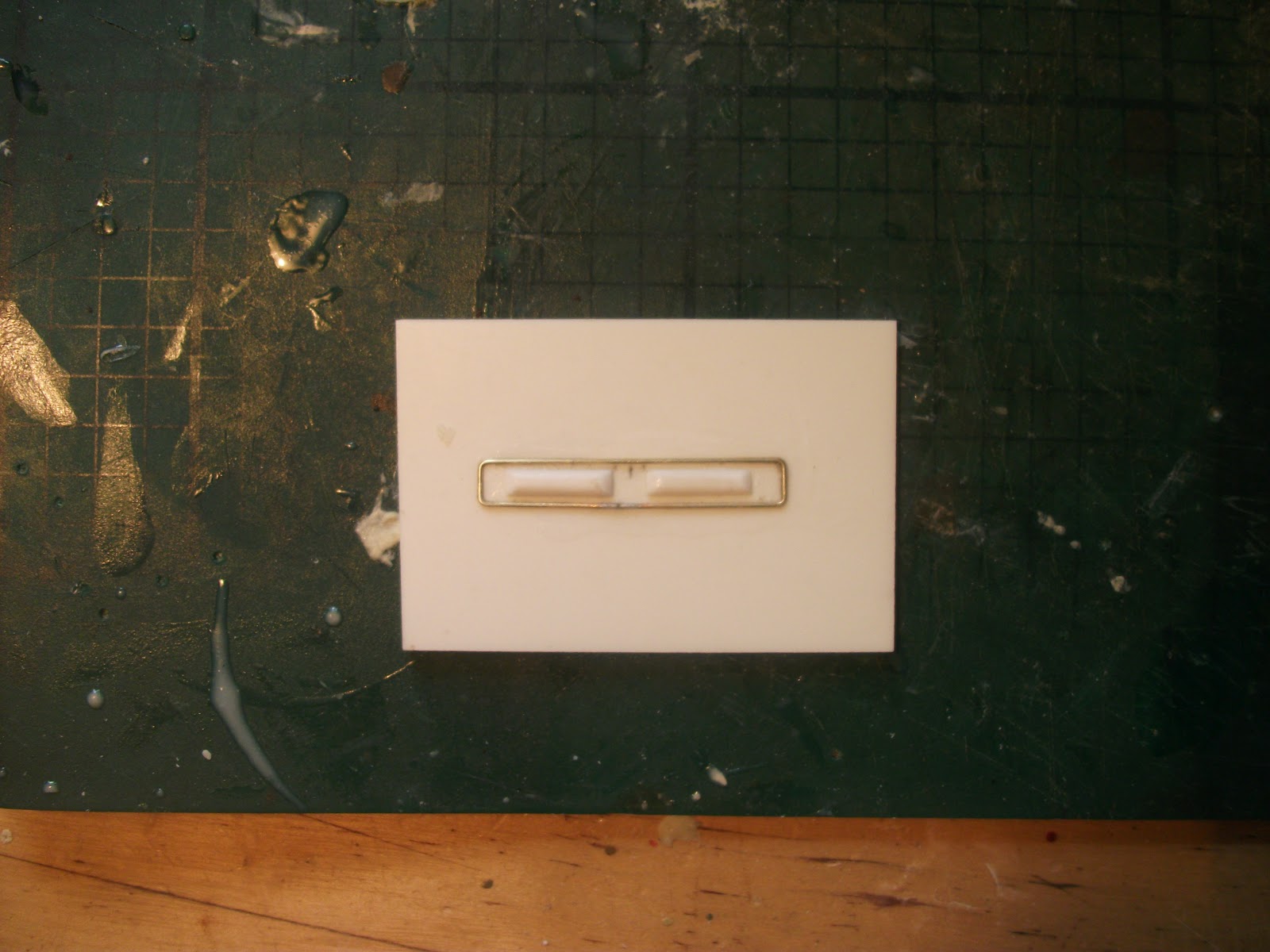
Bumps On The Behind

It's very satisfying to get on with a job you've spent weeks procrastinating about.

The job in this case is the detail on the back of the DZ doors.  The bit inside the wagon. The bit you could get away without doing if you always modelled the wagons with a full load.

Aye, there's the rub.

Finally my modelling conscience got the better of me and I decided it really would be best to try and include these details if I possibly could.

This picture shows you the bits in question.  You'll see that the detail on the inside is the reverse of that on the outside of the doors.


You may remember that I am making the wagon sides in open moulds, which mean the backs are flat. You could have the detail on both sides if you used a two-part mould but my casting skills are not at that stage yet.

So the solution I've come up with is to make some very thin pieces to stick on the back of the wagon sides which hopefully will give the right effect.

The long sausage shaped lumps in the middle are simple enough but I reckoned the challenge was going to be that prominent outer ring.

What I decided on in the end was to make a loop of brass wire - soldering the joint - and then filing down one side of it so that it has a half-round profile when it is glued onto the back of the wagon doors.


Then I made the centre lumps using half-round styrene and stuck them in place in the middle. Here you see them stuck onto a piece of thick styrene to make the casting master.


The theory is that when I come to make the production copies in the mould the sheet of plastic I press onto the back of the wet resin will form a very thin skin across the back of these three parts.

This means I should be able to trim around the edge of the outer ring and glue it in place as one piece. Hopefully you will not notice the skin connecting the outer ring and the middle lumps.