Showing posts with label Cambrian Coast Line. Show all posts

Wednesday, 6 May 2026

Too Posh To Shunt

Himself has been continuing to search for more sneaky ways to improve the performance of the Bachmann 'Dukedog', searching for every last place we can hide a precious few grammes of extra weight.

He's fixed a very thin piece of lead sheet in the cab roof, although it's not visible unless you look for it.

It hasn't made a dramatic difference but every little helps.....

We've also removed the weights from all the standard gauge carriages.  

The Mk1s were already done, and it can just about haul three of them in the Down (Pwllheli) direction only - the tight curve into the fiddle yard going the other way gives too much friction.

We've also discovered why it struggles to push anything up the slope into the yard.

It's not the the steepness of the gradient so much as the effect of the change of gradient.

The Dukedog has a relatively long frame and when it reaches the point where the slope kicks in it tips the smokebox end down onto the front bogie, which in turn lifts the rear driving wheels just enough that they begin to lose traction.

So as far as our Cambrian fleet in concerned 'the Earl' is the loco which is 'too posh to shunt', which all sounds like something the Rev. Awdry could have made a story out of.


Monday, 2 March 2026

Recreating Minffordd Station

I was asked last week if I would write a bit more about how I went about scratch building the station building for Minffordd.

It was an intriguing design.  Many of the stations on the Cambrian, particularly those which were passing places, had reasonably substantial brick buildings with staff domestic accommodation attached, while halts usually had only the most basic shelters.

Minffordd was designed for considerable freight and 'human cargo' interchange, but it was also effectively a halt in the middle of a section.

The building was mostly wooden on a brick base.

And, more the point, when the last staff were withdrawn in the mid-1960s it was quickly taken down with little trace remaining, replaced with nothing more than a large bus shelter!

This made modelling it a challenge because I had nothing much more to go on to establish the dimensions than extrapolating from photographs, making assumption about the sizes of the windows and doors.

The other think I was able to do was take a good look at the Minffordd diorama in the museum at Gelert's Farm.


I had a stoke of luck when one of my FR contacts pointed me in the direction of some archive survey pictures of the station towards the end of its life, which crucially included one taken from the very camera-shy rear of the building.


This showed where a few of the details on the diorama model were incorrect, particularly around how the different parts of the building at the rear connected up.

Having sketched out a design the first step was to create a mock-up in cardboard to test fit on the layout and see if the dimensions seemed correct.


It seemed logic to build it as three sub-assemblies.  The main section at the front, with the open-fronted shelter area, and two extensions at the rear.

As is my way most of the build was done in styrene. 

Making the main walls, with their wooden battening, was made simple by using the Seam Roofing Sheet product in the Evergreen range, which you can get in various sizes of gap between the battens.

The slate roof was cut from the Wills sheets which have been around for years.  They are very thick and hard to cut, but it is worth the effort in my opinion because the moulded slates overlap property.


The sash window frames were fabricated from styrene strip, which is a time-consuming and delicate job, but worth it, I think, to get the depth.

I painted the building using acrylics to look very much like it was very near to being closed. 

The poster boards have had whatever was on the scraped off.


The final details, as you will see in the picture above, were to add working 'gas lamps' and attach the screen for the gents' lavatory on the left hand side, and the crinkly tin outbuilding.


Saturday, 28 February 2026

Regional Identity

I recently added a page explaining more about the background to the decisions we made designing the Minffordd project - 10 Reasons Why - and one of them was about setting it in the period of the 1960s.

Mostly this was dictated by the historic availability of the locomotive fleet on the FR, but there was the happy coincidence that the decade also marked a very colourful period on the Cambrian Coast Line.


At the start of the 1960s the line was still under the control of the Western Region which, in common with others, still seemed to be a bit in denial about nationalisation.

It had conspired to bring back its beloved chocolate and cream carriage livery, at least on its headline named trains, such as the Cambrian Coast Express.

Now we've expanded the fiddle yard capacity we have the happy problem of needing more trains to fill the sidings, so we're exploiting that to justify the investment in a short rake of Bachmann Mk1 carriages which can be found for very reasonable prices on the second hand market.

It makes for quite a rainbow of train formations with other sets featuring grouping-period carriages in all-over maroon and crimson and cream livery, while the DMUs are in their classic green livery.

The chocolate and cream era didn't last long as the WR fell into line and went all-maroon after 1962, followed by the London Midland Region taking control of the Cambrian in 1963.

And, yes, we do know that Manors were only usually seen on the Aberystwyth portion of the CCE, leaving the Pwllheli section to something more mundane, but they did make appearances further up the coast from time to time, sometimes even on freight!

More to the point it's a lovely model - the Dapol version if you were curious - and I've always loved the white paint embellishments applied by Aberystwyth loco crews and cleaners.

And most importantly it's our train set!

Wednesday, 25 February 2026

Cambrian Coast Icons - DMUs

It's well known that nostalgia is in the eye of the beholder.  

In whatever subject we are interested in there will be a period which dominates our memories, and I suspect for most of us that will have coincided with childhood, or when we first experienced whatever this thing is.

So for me, and the Cambrian Coast Line, it's the early to mid 1980s.

I don't think anyone could ever claim it was a golden age - far from it - but if you looked closely it was possible to see the relics of it, such as the last knockings of mechanical signalling.

It was, however, definitely a time when the Cambrian was on its uppers, with Barmouth Bridge closed to all except DMUs - and even then I can remember seeing them absolutely crawling across because of the severe speed restriction, probably moving not much faster than the marine worms were burrowing into the timbers!

I believe before this I can remember seeing a loco-hauled train once, or maybe twice.  A clear memory of a Class 25 with - I think - a breakdown crane at Barmouth station.

So, a young enthusiast on their summer holidays existed on a diet of DMUs, and bread and butter was definitely the Met-Cam class 101.


I always found them the most pleasing of the 1st generation designs on the eye. 

The nicely proportioned front windows in the driving cabs, no great lump of a headcode box above, the chrome window frames, and not being festooned with doors like the high-density suburban units.

So a 101 was always going to be one of the 'anchors' in our Cambrian stock list for Minffordd, and we've gone with the Bachmann version as opposed to the Lima / Hornby offering on account of their very smooth drive, although I am aware that a few proportions were overlooked when the body tooling was designed, but I can't say that I've ever really noticed.

One day I would like to find - or if I'm forced to, repaint - and example sporting the brand-new Rail Blue livery to illustrate the changing scene of our 1960s period, but they seem to be like hen's teeth to get hold of.

I do believe it is important to have variety on a layout, so much as I like the 101's I'm reluctant to run only them.

Our other DMU, then, is a Bachmann Class 108, which were less frequent on the Cambrian, although I have seen plenty of photo evidence.

Were we modelling the era of my childhood, in the 1980s, we could get away with a kaleidoscope of different units.

I can recall on summer Saturdays seeing a wide variety of units from Tyseley and Chester strung, quite often running horrendously late on account of having to pull up many times at the short halt platforms on the coast line.

The one design of unit I would really love to have for Minffordd would be the other one which really sticks in my mind from my younger years when I witnessed the last days of the Park Royal 103s.

Tim Green on Flickr

I would dearly love to see one of the manufacturers add this to their range, it's definitely top of my OO wish list!

Tuesday, 24 February 2026

Finishing Touches

It's a very FR trait to leave a construction project ever-so-slightly unfinished and we like to keep up the tradition in model form!

It is only now, four months after the first exhibition appearances, that the Cambrian station buildings have gained their decorative finials.

These buildings, of which no trace remains today, were a interesting challenge to research and scratch build for the layout and something I think I may return to in fuller post sometime.

I must say, that bench in front of the ground frame cabin (not a signal box) does look a very inviting place to while away some time on a summer afternoon.

What it must have been to have rested here at this summit and heard the sharp bark of GWR engines forging their way up the banks on either side!

It’s something I’m too young to have experienced but if  you still have those memories clear in your mind it would be lovely for you to share them with us in the comments below.


Tuesday, 9 May 2023

Minffordd Update: Tracklaying

It's very tempting when building a model railway to get as much of the track laid as soon as you can.

Not only is it a comforting illusion of progress, you can also begin to imagine properly what it's going to be like to run the layout.

This was a something Himself has had to resist as much as possible on the Minffordd project because the levels, gradients a curve - and the interplay between them - are so complex.

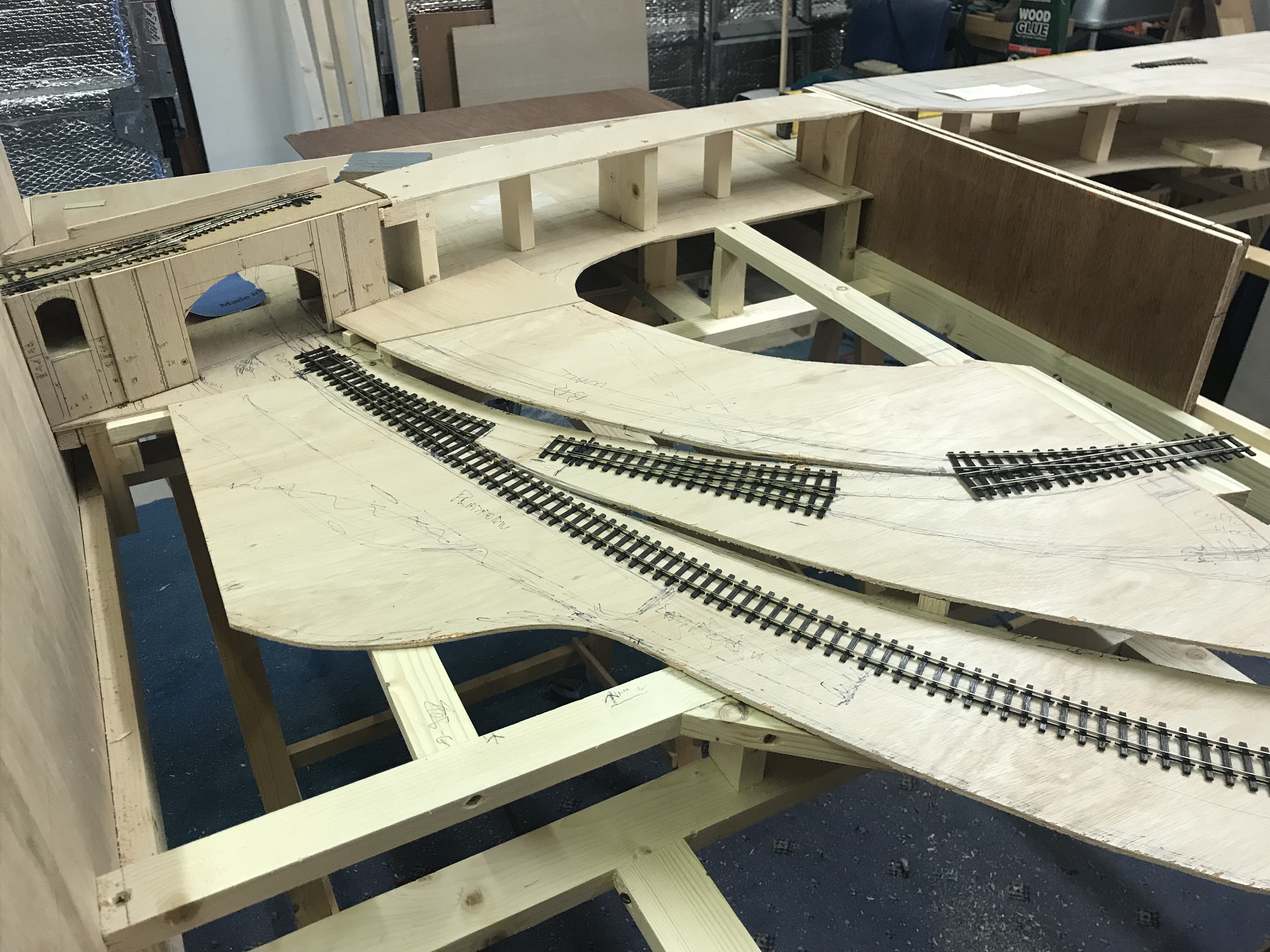
Now, though, he's judged this is the time to fix the position of the points for the standard gauge sidings in the exchange yard.

He's also laid bullhead track on the Cambrian line west of the station as it curls around the front of the layout and disappears beneath our cunningly relocated road bridge.

From this higher angle you're starting to get a good impression of how the whole scheme fits together, and how much of a run a standard Cambrian 2-car DMU gets within the scene.


Sunday, 30 April 2023

Minfford Update: The Coal Hole And Other Apertures

 The process of forming the complex, and compact, trackbed and levels on the Minffordd project is continuing.

The shape of the former goods exchange yard with the Cambrian is becoming clearer, with the sunken 'coal hole' roads now bordered by the wooden formers for the walls.

This narrow gauge lines here will be straddled by standard gauge sidings on either side.

Swinging the camera to face in the opposite direction we can see Himself has formed the bridge where the Cambrian line exits again.


We've played with the geography of the area here to move the lane which crosses the line near the quarry a little nearer the station (with a very sharp bend in the road!)

Here the standard gauge goes into an effective tunnel along the right hand edge of the layout until it emerges into the fiddle yard.


In this covered section the storage lines of the fiddle yard begin to fan out, so to guard against catastrophic derailments on points Himself has created an emergency access flap.


At the other side, just beyond bridge where the FR passes over the Cambrian platform, we already have the start of the fiddle yard roads in place.


This view also shows the transition from the code 75 Bullhead track into the standard code 100 product for the hidden section - the difference in the sleeper size and spacings is very obvious!


Sunday, 12 March 2023

Minffordd Progress

I've just arrived back from my almost-weekly inspection visits to see the progress Himself is making on the new mini-Minffordd project and thought I would share some images.

A lot of the time - and brain power - so far has been taken up with establishing where the track bed levels need to be set.

This gets quite complex in the yard area where we've got the standard gauge climbing up above the descending Cambrian line as it heads down the hill towards Porthmadog, and the FR tracks in the yard which at some places sit higher than the standard gauge sidings, and in others like the 'coal hole' dive down to the bottom of the baseboards.

Our FR mainline running along the back of the scene will also be built on a grade, and just the real line we've got ours on a 1:80.


So far work has been concentrated on the yard entrance area, and the bridge with the FR above.

Those of you who follow us on our Facebook, Instagram or Twitter  (just search for Bron Hebog) will have seen a video showing the engineering solution he's come up with to power the narrow gauge crossover.

Because of the limitations of our design we've had to slightly relocate where the points go with the result that if we tried to put a motor beneath the northern turnout it would fill the pedestrian underpass!

Next he'll be focussing on extending the Cambrian line along the front edge of the layout where it will pass under a (slightly relocated) road bridge - disappearing out of sight beneath the FR branch helter-skeltering down into Minffordd Yard - and the fanning out into some hidden storage loops.

Yes, it will all be quite compressed, but we hope it will be amusing to watch and engaging to operate.