Sunday, 13 November 2016

Split Ends

The carriage ends are normally quite simple but 125 requires a bit more brainpower because they are not identical.

The trickiest aspect is accounting for the difference in their width.


The problem is that one end of the carriage has the vestibule doors inset as on a regular Superbarn saloon while the other is at the full width of the body.

I've had to make some calculations (and cross my fingers) to hopefully ensure that when it is all joined together the two body sides will be running parallel and it's not narrower at one end than the other.

At the point where my brain started to hurt I decided to stop theorising and just cut some styrene and see what happens....


Friday, 11 November 2016

Operation Observation Undercoat

If building 150 from scratch was a daunting prospect then so must painting it - more accurately lining it out afterwards.

So I'm impressed that Himself has grasped the nettle and started the process by giving it a coat of primer.


Before this there were a few little jobs to finish off like fitting the gutter down pipes at the back and the train vacuum pipe along the length of the underframe.

The vac pipe on the very front won't be fixed into position until the painting and lining is complete.


Wednesday, 9 November 2016

Two More For The Fleet

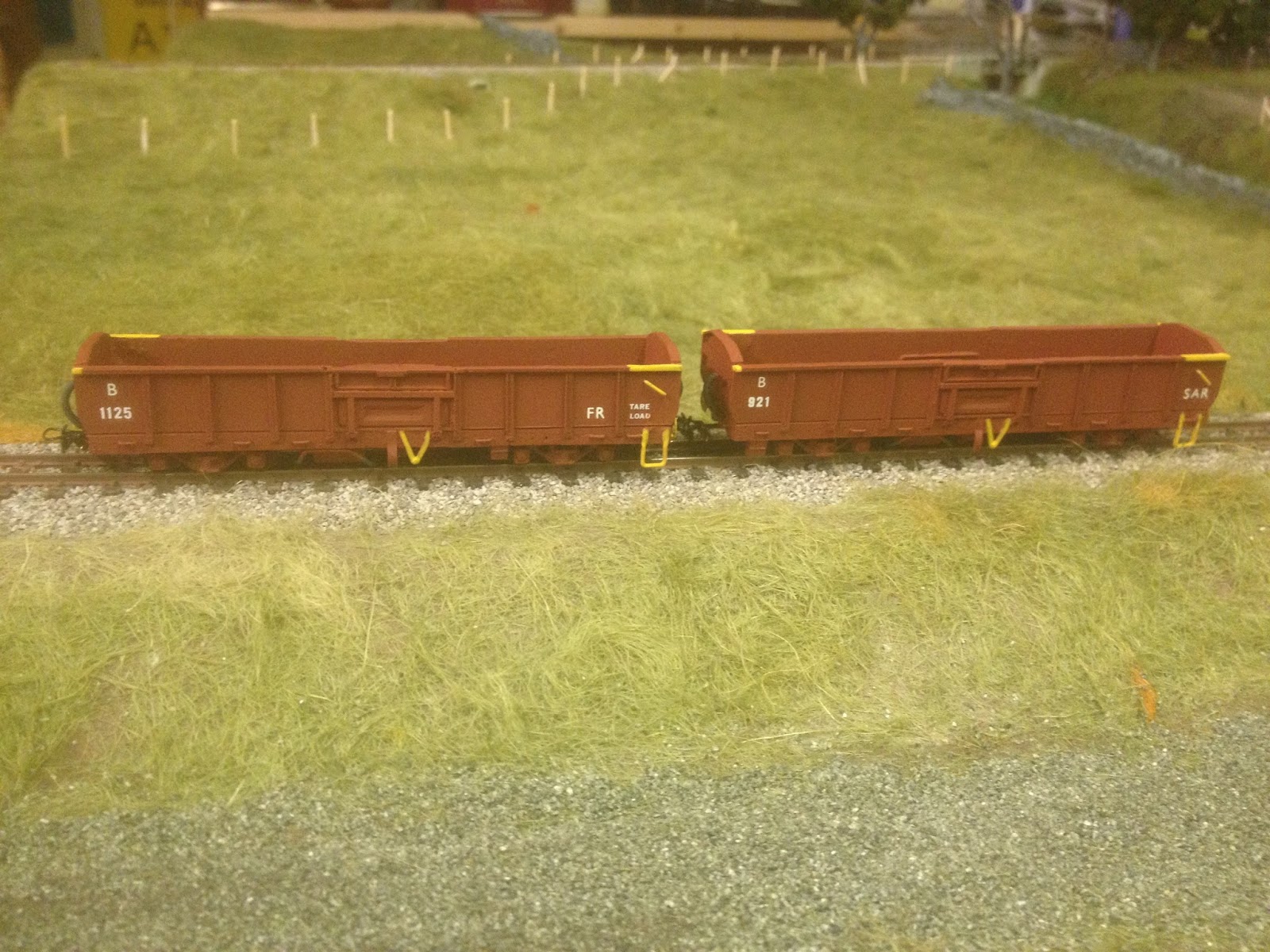
The two most recently-built B wagons have been varnished and are ready for service.


Quite honestly I've begun to lose count of how many of these we have now - and the real F&WHR for that matter, too.

I think we're quite well off for this later design, which I can knock out quite easily in resin, but I suspect we have not yet got a full compliment of the other type which are built from a Worsley Works scratch-aid kit.


Rather that take a boring picture on the work bench I thought I would pose them on the section of the layout which is up in the garage at the moment for the fence post installation.

The difficulty was that - like the real location - there is a fierce gradient around our S bend and I had to resort to placing a discreet blob of Blu Tac on one of the rails as a makeshift stop block to prevent them free-wheeling into oblivion while I took the snap.

Monday, 7 November 2016

Middle Door

So, I plucked up the courage to slice the other side of 125 almost in two, except for a sliver of a cantrail along the top.

I won't pretend it went like clockwork.

As soon as I had removed the section of lower bodyside I decided that the gap didn't look quite big enough and I set about relocating the window pillar on the right, which was not as simple as it sounds because by this point it already had all the beading in place.

That had to be carefully peeled off before chopping out the pillar and moving it a mm or so along the way.

Satisfied, at last, with the positioning I built up a section behind and formed a doorway.

Here's how the finished side looks from the front.


And from the back you can see how far into the carriage body this doorway is set.


I shall turn my attention to the ends next, which are not identical.

For the Caernarfon end I can use a set of standard double door superbarn castings but the other, which is a regular, full-width affair, will be scratch built in styrene.

Saturday, 5 November 2016

Marching On

If there is any job more boring that ballasting on a layout could fence post installation be a contender?


Himself has continued working his way along the layout drilling and inserting fragments of cocktail sticks.

Unfortunately for him this is only a fraction of the distance he's going to have to cover all around the S bend.

He's also taken a diversion down the road from the top crossing (called Bron Hebog) and past the farm house to the lower crossing.


It's a nice view, isn't it, if you can ignore the spray cans on the shelves in the background.

Thursday, 3 November 2016

Full Circle

When Himself is a man on a mission things progress rapidly.

Therefore it took only a week from him being press-ganged into purchasing some pre-loved lengths of PECO OO at the local exhibition to The Trainee being presented with his first proper train set.


Not content with a mere oval Himself has squeezed in a passing loop and a siding with headshunt.

(I should explain at this point that although he ended up sending a crate-load of plain track to the tip when he moved house last year he held on to all his old points - go figure.)

This has all be laid out on the baseboards which were used for the temporary fiddle yards when Bron Hebog was being shown as a work-in-progress at various points in recent years.

They're connected by hinges so it can be folded up and stored behind the sofa in the snug.

(How cunning, eh?  Not content with an entire double garage he is now moving model railway stuff into a second room in the house!)

He's sorted out a selection of locomotives and rolling stock for The Trainee to play with which are a mix of the expendable and the indestructible - the expandable being some prehistoric Triang Mk1's which have already been vandalised once by me 30 years ago practising my carriage panting skills, and the indestructible (?) being a handful of metal Wrenn steam locomotives.

(I put the question mark in brackets because we discovered the other day that unbeknown to us one of the buffers had sheared off a Wrenn BR Standard 2-6-4 at some point in the last quarter of a century.)

The eagle-eyed my also notice the obligatory Hornby 'Caley Pug' (in mock L&Y livery) and some four wheelers.

What self-respecting 3 year old's layout doesn't have one of those?


Tuesday, 1 November 2016

Hole In The Middle

After a break of a few weeks I've picked up where I left off on the service car 125.

The first task was to add the top layer of beading.


This, the engine side, still has a gaping hole in the middle where the generator doors go.

My strategy for this was to make a separate unit to glue into place.

The first step was to create the door frames on a thin piece of styrene.


The louvre doors have been a compromise on all the service car models, both the FR and FR types. What I've ended up using to represent them is clapboard styrene.

Small sections were cut to size and placed inside the door frames.


And then the whole piece was fixed in place, completing the carriage side.


The opposite side, the clock side, also has a challenge right in the middle.

Instead of a hole to fill in I have to cut out a section of the lower body panel to create the recessed doorway.

Get it wrong and I may have to re-do the whole side. No pressure then...