Showing posts with label Super Barn. Show all posts

Friday, 20 May 2022

A Bit Of Bob

It's been so long since I did any narrow gauge model making that I can no longer remember what it was, or when it was I was working on it.

However, the castings for FR super saloon 808 (aka BOB) have been gathering dust on the shelf and pricking my conscience for many months now, so I this week I decided I'd better pull my finger out and do something with them.

Part of the reason for the long delay - aside from a general lack of motivation ever since the Glasgow show - is I had run out of the 60 second superglue I've taken to using for assembling resin parts.

It has the benefit of allowing a decent amount of repositioning while not leaving you waiting for ages for the parts to bond, which I've found has always been the case with the so-called 'rapid' epoxy resins.

However, in one of the small DIY shops in town - and we are fortunate to have two here - I came across a 90 second Araldite product which comes in a double syringe dispenser thing.

I was sceptical whether it would actually bond in 90 seconds - it's more like 490 in my experience - but the join does seem to be less brittle than one made with superglue is.

We shall see how it stands up to all the handling as I fit the floor and roof.


Friday, 19 October 2018

Table Tops

Sometimes it's tricky to find a task to fill a spare half hour at the modelling bench.

If time is limited you don't want to start on something involved only to have to put it aside as soon as you've started.

This is partly why there hasn't been any progress on the latest Super Barn 119 for a while - that and the need to produce that batch of wagon kits I was working on.

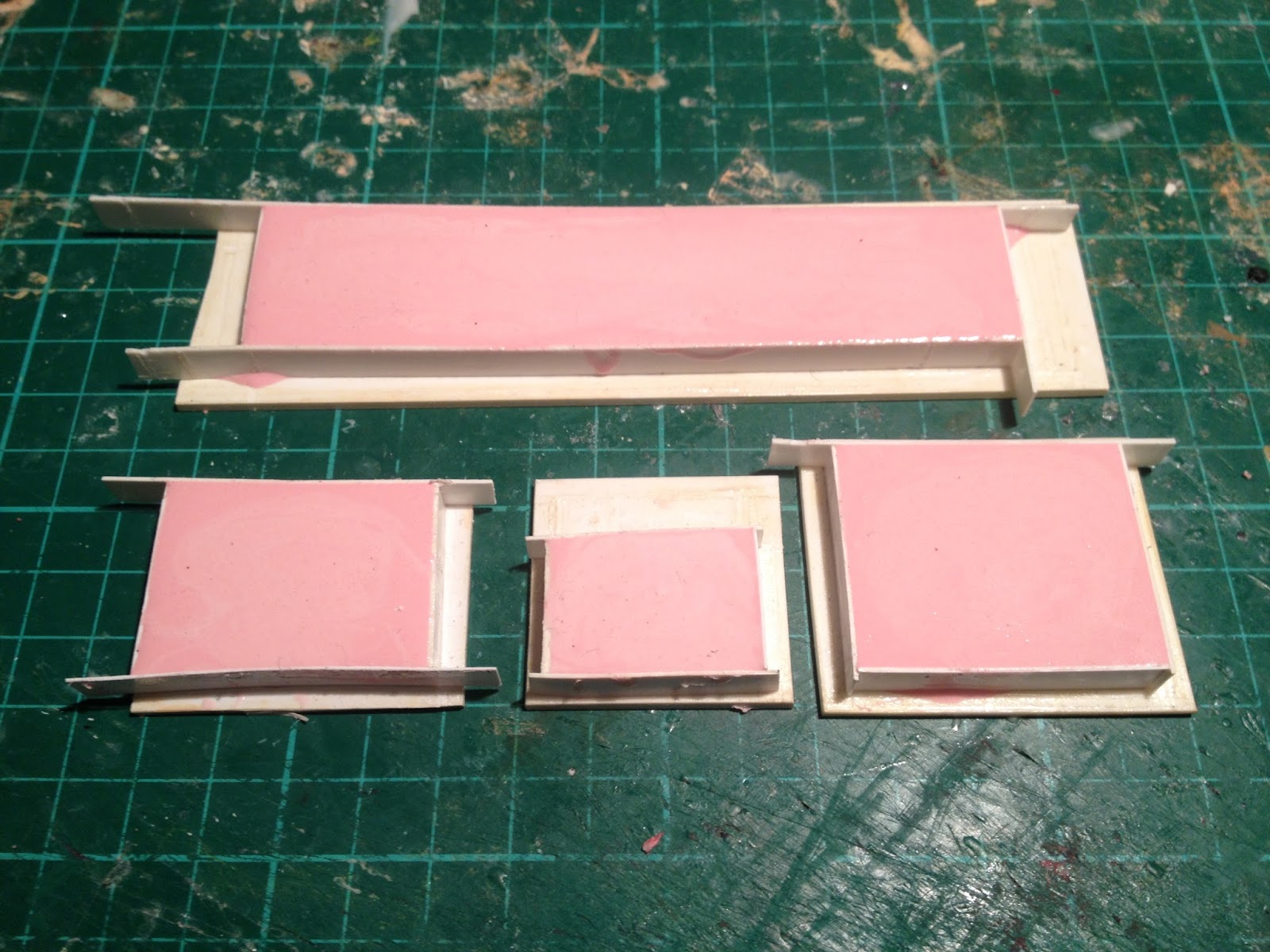
Anyway, I had a few minutes to myself the other night, and wondering what I could usefully get on with, I decided to clean up the interior castings and glue the table tops into position.


I think will try and get the underframe detail fixed onto the floor first before I glue the seats into position - tempting though that is as a 'quick win' - because sometimes the effect of the glue can cause the floor to bow upwards.

As always in this game, patience pays off.

Friday, 21 September 2018

Super Duper Barn

I did get some modelling done in the days before we left for Wales, in fact there was quite a burst of activity on my latest superbarn 120.

In the last post about the carriage I had just begun the process of cleaning the flash from the windows, and I managed to get that completed, made up the corridor connections out of styrene (a fiddly job I'm not fond of) and glued them together into a basic bodyshell.


Once that's done, and in order to protect the rather fragile superglue-on-resin joints, I try to make up the floor and false roof so that they can help to keep the carriage square and stop it flexing about too much.


Incidentally, while I was in Wales for Superpower I learnt a new nickname for these carriages which amused me.

The first three were designed with regular droplight windows in the middle of each bay of seats, in line with the tables.

They became known as 'Super Barns' in a nod to the original series of Centenary carriages build in the 1960s.

The most recent four carriages have been revised with much larger windows with hopper windows set into the toplights, which a friend referred to as 'Super-Duper Barns'

I rather like that.

The official name for them, I should point out, is Super Saloons - but I've never heard anyone call them that in conversation and I'm not about to start here.

Monday, 3 September 2018

Falling Behind

I've let Boston Lodge get ahead of me in the carriage-building stakes again and this autumn I shall have to play catch-up.

I've had these castings for super barn (sorry, super saloon) 120, set aside for quite a few months but the motivation to put it together was lacking whilst all the while the real carriage was commissioned and put into service.


It's a terrible thing to say but sometimes you can get a little bored (just a tiny wee bit) of making similar models - even if the carriage works crew are always keeping me on my toes with their sneaky alterations to the design.

By my reckoning this will be the seventh super barn saloon I've built, and the fourth of the revised design with the big windows, so you can maybe understand why the novelty has worn off.

However, there's nothing else for it, I need to man up and get on with it, so I retrieved the castings from the photo album where they've been safely squashed all this time, and begun the process of cleaning up the flash from the casting process.

I got the first one done and then, as they used to say on kids summer holiday telly when I was young, I went off and did something less boring instead.....


Friday, 4 August 2017

The Pips

After the trauma of fitting the truss rods (every time!) making up the boxes which represent the various things hung under a modern FR carriage - such as the diesel-burning heating unit and the associated fuel - is child's play.


Of course, no model of the FR Superbarn carriages would look quite right if it didn't have something to represent the distinctive blocks along the side of the underframe.

In fact these are brackets which support the sightly wider wooden body which you can see on this shot taken earlier this week of the under frame of what will be 120 in the welding bay at Boston Lodge.


In my case I don't bother to try to make scaled-drown brackets, instead I just glue small cuts of styrene strip in the right places.

It looks effective as far as I'm concerned and that matters as much as rivet-counting accuracy in my book.

Thursday, 4 May 2017

Never The Same Twice

Himself spent the weekend in Wales enjoying the Quirks and Curiosities II weekend on the FR.

(Some of us still have to work for a living on Bank Holidays.)

Naturally I armed him with a list of things I needed pictures of during his visit to Boston Lodge Works.

The first thing reported back to me - which will come as no great surprise to readers of this blog - is that the second of the Super Barn observation cars, to be numbered 152, will not be an identical twin of the first.

152, or at least the steel skeleton, was transferred from Dinas a few weeks ago and the carriage works team are already working their magic with wood.


The breaking news, for me at least, is that 152 will be different at the front to 150.

Instead of one single pillar at the front of the observation saloon it will have two either side of the centre, making it look a bit more like the WHR Pullman 'Glaslyn' perhaps.

More frustratingly there is another very subtle change at the front.

Unlike 150 which was flat across the centre above the drawbar, 152 is being built with a very slight curve, as you can see in the picture below.


This means that I will certainly have to create a new master for casting the front section of 152 when I come to build it - and this piece was one of the most challenging aspects of doing 150, so as you can imagine I am delighted about that!

I now have my fingers crossed that the sides will be a match for the first carriage so I can at least re-use those parts.

It is probably a forlorn hope.

Thursday, 17 November 2016

Properly Parallel?

It was the moment of truth for carriage 125 the other day.

Having completed the ends with my best guesstimate of their respective widths there was no reason to delay gluing it together and see whether I ended up with parallel carriage body or not.


I'm relieved to say it looks like I have, and I'm rather pleased with how it's come together.

The cast resin vestibule end fixed on without difficulty to the styrene body sides.


More importantly I think, at this stage, it's definitely got the look of the prototype, wouldn't you agree?

Sunday, 13 November 2016

Split Ends

The carriage ends are normally quite simple but 125 requires a bit more brainpower because they are not identical.

The trickiest aspect is accounting for the difference in their width.


The problem is that one end of the carriage has the vestibule doors inset as on a regular Superbarn saloon while the other is at the full width of the body.

I've had to make some calculations (and cross my fingers) to hopefully ensure that when it is all joined together the two body sides will be running parallel and it's not narrower at one end than the other.

At the point where my brain started to hurt I decided to stop theorising and just cut some styrene and see what happens....


Monday, 24 October 2016

Swap Shop

One of the more mundane jobs on the workbench at the moment is a re-bogieing programme on the Super Barns.

The final two are going through the process.


Because these bogies, which we make ourselves,  are much longer than the Dundas-based mash-ups we've been using since the we started scratch building FR carriages over 25 years ago, they don't have enough room to swing under the body and Himself has to carefully hack away at the underframes so they can run on the tighter curves on Dduallt.

We still have a mountain to climb, though.

While we'll soon have the Super Barns all sorted, nearly all the rest of our modern carriage stock will need to be tackled.

That's more than two dozen carriages, I reckon.

This is going to be a long road indeed!

Friday, 24 June 2016

Seating Installed

I can report back on my rather pricey tube of glue and..

..I'm quite happy with it, actually.


I doesn't quite give you the full 60 second adjustment time 'like it says on the tube', but it's not a completely instant bond and I was able to shift the seats and tables slightly after I'd dropped them into place.

I think this may be the last knockings of the old mould for the seat units, however, because the tables came a bit taller than they should have done.

Well, 1mm or so, anyway, but it makes me think that perhaps the rubber has stretched a little as the parts have been removed each time.

This meant I had to go through the rather dull process of sanding a little off the bottom of each casting on a sheet of sandpaper before gluing it on.

Otherwise it all went quite smoothly.


Thursday, 21 April 2016

The Inter-Valley 125

I wrote the other day that I'm developing a backlog of carriage projects and here's one of them, the FR's latest 'Service Car' 125.

Pic: Bruce Brayne

It made a public debut last weekend along with its running mate Observation Car 150.

(The pair have to go around together because 125 has the brake setter.)

This Super Barn Service Car is going to be a very interesting build because it includes a lot of new features.

Firstly, unlike the other Super Barns, it is single-ended by which mean that it only has the inset vestibule doorway at the Down end.

Not only is the up end full width it is also more traditional in not having windows on either side of the corridor connection.

The big windows are worthy of note. Some have sliding openings which meet in the middle while others do not.

Some are full height will others have a horizontal bar about a quarter of the way up (on the other side which you cannot see here.)

Some are clear and some have a mirrored finish. Some are blanked out in black or opaque.

In common with the other Service Cars the 'engine side' is quite literally that, because in the centre of the carriage is a compartment with a generator unit which is accessed through vented doors.

On this carriage, however, the upper louvres have been painted black rather than ivory. I'm guessing this is an attempt to camouflage them in the middle of a body side full of large windows?

The really interesting feature - and that's interesting as in the sense of a total pain in the posterior to model - is the central doorway on the 'clock side' as seen above.

Because this is recessed I would normally have to build the main body side as two pieces which are then spliced together with a doorway that is then attached behind.

One of the challenges in doing this is to ensure that it ends up precisely the same length as the other side which can be made as one piece.

There is, however, another complication which is the cant rail which runs all the way along the top.

In the light of this I am considering another solution where I would make a full body side as normal, but then chop out the lower solid section where the doorway is to go, leaving the two halves held together only by this thin strip of styrene along the top until I can glue the new doorway behind.

That way I wouldn't have to worry about whether the body side is the correct length although I would have to take care that it remains square and level and doesn't bend like a banana when the new section is bonded in place.

The boys at Boston Lodge never make it easy, do they!


Friday, 30 October 2015

Book Of Barns

Notwithstanding my dictum not to finish one project before starting another I have taken the liberty, while I had the resin out, to cast myself a new pair of Super Barn parts.


They're destined to become models of the FR's newest carriages 117 and 118.

The former is about ready for painting as I understand it while the latter is being built up from a kit of parts.

My only hope is that I haven't jumped the gun and that both of them will turn out exactly the same as 119.

If not I'm in trouble....

Tuesday, 22 September 2015

Winter Work Programme

The pace has slowed a little after our return from Dinas and the flurry of activity in the weeks leading up to it.

Himself will be taking an extended break from modelling and right now I've got my commercial hat on to meet an order for more SAR wagon kits to restock the FR shop.

I have decided to make a strategic reinvestment and have cast a fresh set of moulds for all the components of the four kits, expect the main chassis pieces which get 50% less use.

These are just a small selection with the rubber curing in the moulding boxes...


Casting a couple of dozen kits is going to keep me busy for a couple of weeks.

There's the Cwm Cloch farmhouse to finish as well

Then I'm going to push the boat out - and break my biggest golden rule - and cast another couple of MkII Super Barn carriage bodies.

Photo courtesy of FR
That's carriage 117 which is fast approaching completion at Boston Lodge and work on a replacement 118 is already underway.

The insiders who whisper information into my ears are utterly insistent that these two carriages will be identical - note the word, identical - to 119 which was rolled out last year.

When I made a model of that last year you'll remember I very optimistically made styrene masters and cast the body sides in the hope that I would be able to use them for the following carriages.

The moment of truth is nearly here and if I should subsequently discover any significant difference between the three carriages.......

Following on from those, and something that I'm really going to have to be in the mood for, is the fancy new Observation Carriage 150.


It was on display in the bay platform at Dinas during Super Power: Great & Small II so I had a good chance to poke around it and take lots of research pictures.

I've got a fair idea how I'm going to go about making it.

That's my mid-winter project I reckon.

And finally, more houses...


After the carriages I shall crack on with the end row of properties in Oberon Wood.

As you can see they are as idiosyncratic as the rest,

Lucky me!

Wednesday, 2 September 2015

Colourful Carriages

Himself is very busy attempting to finish off some more rolling stock with the exhibition at Dinas just a little over a week away now.

Carriage 16 looks a real rainbow of colours when it is disassembled like this..


He's also been putting the finishing touches to the third of the 1st generation Super Barns 108...


It isn't just carriages, either.

Work has restarted on our new Conway Castle


The main blocks of colour are all there and the challenge now is to add the rather complicated lining where they meet.

Thursday, 8 January 2015

Super Barn Signed Off

While I was down visiting the rest of the family over Christmas I took the opportunity to deliver the model of new Super Barn 119 which I was working on in the last months of 2014.

My part in the build is now over and Himself will finished off the remaining jobs which include a brass roof skin, handrails, the vacuum pipe and hoses and the bogies.


The last thing I did to it was to add the bits and pieces under the floor including the battery box, fuel tank for the heating system and something to represent the bit of the brake gear which can be seen hanging down beneath the frame.


I was also shamed into rebuilding the support struts for the truss rods following some feedback from a friend on the FR that the first attempt didn't look quite right.

Well, we can't have that!


Monday, 29 December 2014

Review of 2014: Part 1

January

In the final days of the year I like to look back at everything we've achieved in our modelling at opposite ends of the country.
January 2014 began with Himself putting the finishing touches to our model of Welsh Pony which he built - after a long struggle - from a Mercian Models kit.

It looks better than it runs, which is mainly on account of some distinctly un-centred wheels, and nothing more has been done on it in the last twelve months.

We shall wait until the FR has completed the restoration of the real Welsh Pony, but as they're making impressive progress on that we shouldn't have to wait too long.

It's also amusing to look back and see that the year has been book-ended with me casting interiors for Super Barn carriages.

Back in January this was the first one I'd done.


Himself was also starting work on making our third NGG16 from the fabulous Backwoods Miniatures kit.


February

Progress was so swift that by the next month I was reporting the completion of the rear power unit. I could look at that valve gear all day...


I was cracking on with making a trio of Super Barn carriages for a client with the body parts cast in resin and the roofs cut from an empty super-sized beer can.


It's a hard life sometimes!

The Artistic Director also produced some long-awaited plans for the 3rd & 4th houses in the Oberon Wood estate which were a true work of art as always.


March

It didn't take me very long to get the first of the houses knocked up in styrene.


Himself sent us some 'works portaits' of our completed 138 which, unlike Welsh Pony, moves as good as it looks.


And with the deadline for our next exhibition appearance in September a big push began to try and get the layout as complete as possible.


April

Things started getting heavy, quite literally, in April as Himself began work on the rock faces in Cutting Mawr using real Welsh rock.


May

By this time I'd sent down the 3rd house which was in the process of being positioned on the layout and the landscape built up around it.


The 'Head of Steel' advanced rapidly with track being laid on another new board, the gently curving section which makes up the final part of the big S bend behind Beddgelert station.


June

I was being kept busy making another batch of Super Barns for another client, this lot had to be supplied painted but without interiors.


At the same time I was also getting on well with making the 4th house for the estate.

There are common themes to the designs but they are all different so you have to pay close attention to the plans drawn up by the Artistic Director and cross-check with my on research photographs.

This one required some corrections late on in the build process...


At the back of the layout Himself was making the last of the bridges over the Afon Cwm Cloch.

Here is a shot of him checking clearances with a Garratt and the longest carriage, the Pullman observation car 'Glaslyn'.


To be continued....

Monday, 15 December 2014

Tricky Truss Rods

Another one of the big changes on this 4th FR Super Barn, the new 119, is a new design of truss rod - and it's a bit of pain to model.

Most other carriages have two plain support posts which descend from the frame but the ones on 119 have a triangular design.

Not only that, but the truss rods themselves have anchors mounted below the frame - square boxes which the ends disappear into - instead of continuing on up to an end point hidden inside the frame.


So how was I to replicate this?

The proper way, on course, would be to mount some boxes with holes drilled into which I would poke the ends of the truss rods.

However I saw a number of issues with this.

I would have to drill holes at an angle in a small block of styrene. Tricky.

As well as bending the angles in the brass wire - which his always something of a trial and error process - I would also have to cut them to length very accurately. Again, tricky.

And unless all this was positioned perfectly I foresaw a chance that there would be a lot of strain in the structure, either on the boxes representing the anchor points where they are glued to the frame or where the wire is glued to the support posts.

So in the end I decided to cheat!


You can see in this picture that I've mounted the truss rods in the same way I have on every other Super Barn,

There is a more-or-less 90 degree bend just beyond where the anchor point is supposed to be, and some styrene strip is glued in front and along the bottom to appear like a solid box for those who aren't looking too closely.

You can call me a coward if you like.....

Saturday, 13 December 2014

Soft Furnishings

I managed to eek out the last of my resin to cast a set of seats and tables for the new Super Barn 119.

I'm pleased that the seats which I produced for the first trio of Super Barn fit perfectly in this redesigned carriage with the seat backs lining up exactly with the window pillars as they should.


This is more remarkable than it may appear because you have to take into account that I had to draw out my own plans for this model because Boston Lodge does not appear to have anything approaching a drawing of its latest carriage, only a 'back of a fag packet' sketch as I previously posted about.

So clearly I got my calculations and scaling spot on.

While on the subject of furnishings I should perhaps explain and apologise to any reader who has become a little bored that there's only one project on the go to blog about at the moment.

What's Himself been up to you may wonder?

Well, after our return from Hull, Himself has finally had to give into to demands to refurbish the spare room cum office cum modelling room, a task which he has managed to dodge and defer for the best part of two decades.

The problem is now he's finished it the domestic authorities have ruled that he's not allowed to model in there any more lest he should contaminate the new carpet with paint spills or solder splashes!

So he is banished to the garage which has been rather chilly of late, and you know how pensioners feel the cold....


Thursday, 11 December 2014

Re-Moulds

Before I can cast the seats to go in 119 I need to renew the mould.


This is the third mould I've made from the master now.

I usually reckon that each one is good for around 20 casts, but with each Super Barn carriage needing 7 sets of tables and chairs you can see that I have to produce a new mould after every third carriage or so.

Because the seats are quite deep - at least 1cm high - the mould swallows a lot of RTV rubber, about 30g, which is usually enough to make a mould for a typical SAR wagon side.

So I can get many more wagons out of each mould than I can carriage interiors, which I suppose makes these seating sets less efficient to produce.

That said it's still much quicker and easier to cast all the seats than it is to make them from scratch.

Tuesday, 9 December 2014

Loving The Jobs You Hate

There are times when you just have to grit your teeth and get on with the more boring bits of a model build.

For me this is invariably the corridor connections.

In my book they're absolutely essential items to getting the look of modern FR / WHR carriages right.

I have seen quite a few models of FR Barns made from the various brass kits on the markets but hardly any of them have had the hinged extensions added on let alone anything which represents the rubber folded and fixed at the ends where they rub up against the neighbouring carriage.

And no matter how well made, or well painted the carriage it just looks wrong.

(Unless, of course, it's a Barn in its very original, teak-liveried condition)


And that's why I think it's worth going to the effort of making them, but I won't deny it is an effort.

Each piece - and there are 6 of them needed for a carriage - is made up of 4 bits of styrene, so that's 24 pieces in total to be glued together and shaped.

I've written a full step my step guide on the blog before so have a search back through the posts if you're interested in having a go yourself.

Even when you've done the fiddly part of gluing together the U section (rubber bit) and fixed it into the main piece which connects to the carriage end you've got to shave it with the scalpel blade, file and finish it off with emery paper to give it a convincing, rubbery appearance.