Showing posts with label England Engines. Show all posts

Tuesday, 3 March 2026

Getting It Straight

When we set out to make Minffordd it was with the intention to make as much use of ready-to-run rolling stock as we could.

That may seen an odd approach for a layout team best known for amassing a huge collection of kit built and scratch built stock but we wanted to get it made as quickly as we could.

Wanting to have DCC sound on the layout was the other major consideration - so much easier with RTR!

However, there were still some locos which required some serious hacking about to be correct for our era, and one of them was Prince.


The era we are modelling Prince in the 1960s is the period where 'The Old Gent' was going through something of a mid-life crisis.

He hadn't yet started bulking up on the steroids - that came in the 1980s - but to try to keep up with the younger Ladies who appeared on the railway the decision was made to strengthen his frames and take out the classic step up beneath the saddle tank.

This look, which lasted for less than a decade, wasn't included in the 'tooling suite' for the Peco / Kato Small England so it was necessary for us to take the knife to it.

The good news is that the body breaks down into sub-assemblies, and the frame is one of these.

It was a relatively simple job to chop out the stepped-up section and join the two halves back together with some thin brass strip and fix the saddle tank section back on top.

To be completely authentic we also filed away the ballast weights in front of the smokebox and the resulting hole was disguised with some brass shim.

As the loco had to be completely disassembled in any case to hard wire in a DCC chip it didn't mean that much extra work.

Prince has come to be perhaps our most essential locomotive for operating Minffordd Yard because - on account of his traction tyres (I might have been wrong about those....)-  he's the only loco which can haul a full rake of wagons up to the Mineral Line,  all the rest have to drag them up a couple at a time and assemble the rake in the siding at the top.


Wednesday, 21 June 2023

Pulling Apart A Prince

Even though 009 is fast becoming a ready-to-run scale its good to know that some old fashioned modelling is required to produce the appropriate locomotive fleet for our Minffordd layout.

A consequence of Kato/Peco beating Bachmann to the punch on producing a model of the Small England engine is that the differences between the versions put on sale so far are confined to decoration rather than changes to the body tooling.

This means, as far as Prince is concerned, the most current version they can (accurately) make is more than 60 years old.

The first example of extreme tinkering - others would say butchering - at Boston Lodge in the preservation era was when 'The Old Gent' emerged from it's first overhaul with the distinctive stepped frame beneath the saddle tank turned into a straight beam which ran the length of the locomotive, with a pronounced gap now beneath the tank.

This is the way it would have looked in the period we are going to run our Minffordd layout.

It ran in this guise for around 6 years before being withdrawn again and emerging in 1980 looking like a body builder who has overdosed on steroids.

Fortunately, the main component parts of the body are designed in such a way that the frame can be easily separated from the saddle tank, cab and smokebox to allow for some corrective surgery to be attempted.

I know it's possible because it's already been done by the model designer (and a very good job of it he's done, too) and he's kindly passed on some notes on how it was done.

As you see in the picture, Himself has disassembled the model and is awaiting supplies of appropriately-sized brass strip before he begins chopping.


Monday, 23 May 2022

Toned Down

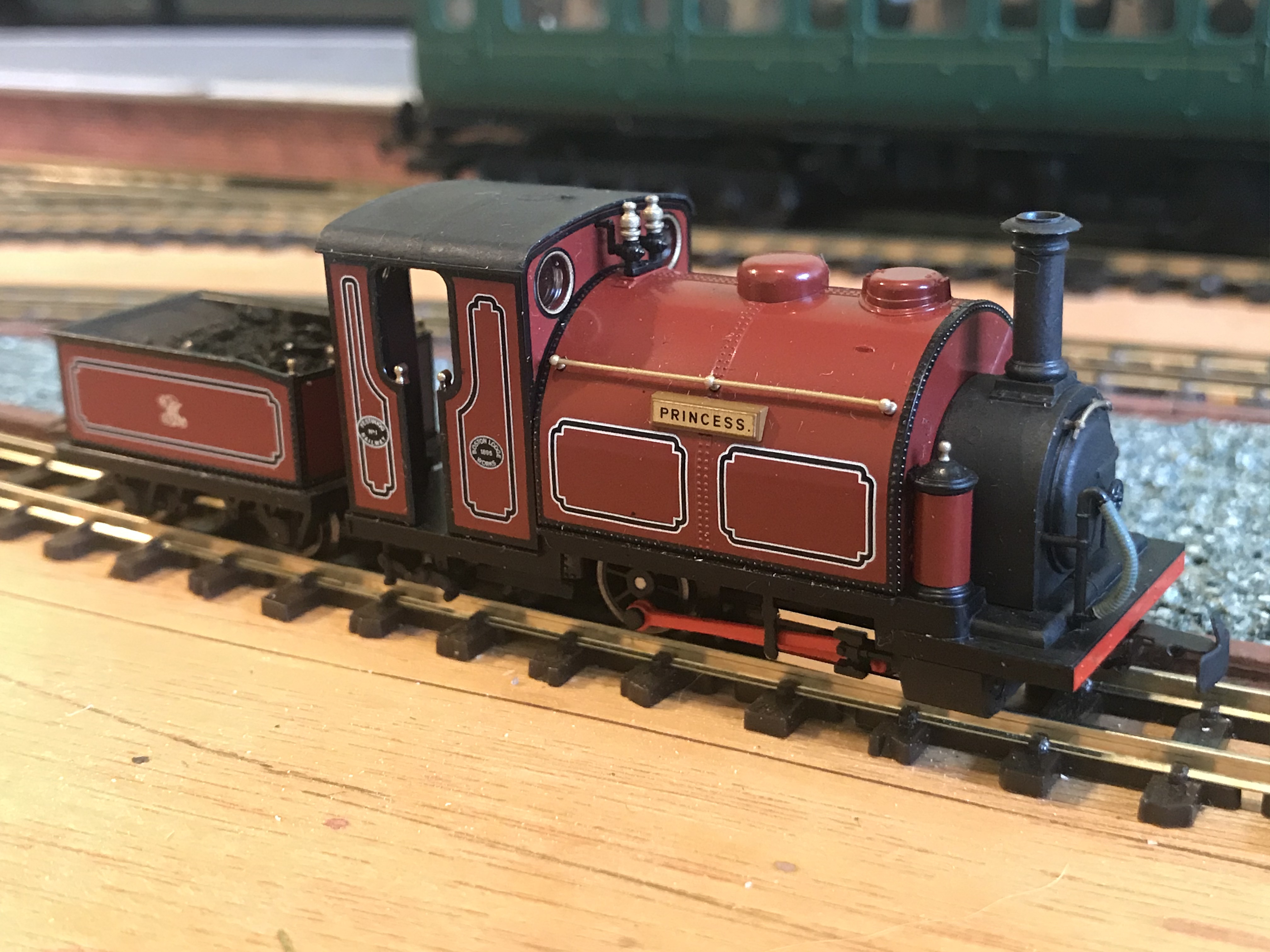
Princess has returned to the test track from Himself's where it had been sent for the application of a little subtlety.


As it comes out of the box the Kato / Peco England has a number of things which betray that it was produced to a price - or for a certain aspiration of specification -  but these can be easily attended to.

Among the things Himself has done is apply some black paint to the upright at the end of the slidebars, which stands out like a sore thumb in silver.

A brush over with matt varnish makes the smokebox look like a loco that's had a fire in it, and the cab roof looks an awful lot better when it's not black and shiny.

It's also had the happy effect, to my eyes, of making the chimney look a bit fatter and much more prototypical.

The vac pipe bags look a lot more realistic when they are no longer black plastic colour.

The last thing he's done, which you might not notice until I point it out, but is one of those things you can't unsee once you've spotted it, is to run some black paint around the edges of the cab opening,

The livery finish on these models is really very good, but they are badly let down that in places like the cab doorway the black edging is only on the sides and doesn't extend to the edges which remain shiny, maroon-coloured plastic.

It really stood out when you looked at the engine in 3/4 view.

It's such a small thing but it makes such a difference when you fix it,


Sunday, 27 March 2022

(Not) Ready To Run

It wouldn't surprise me if Peco's PR people are a little frustrated this weekend.

(And if they're not, then they ought to be.)

For days my social media feeds have been full of excited narrow gauge modellers receiving their England engines, but as the week wore on the pictures changed from delighted owners posing their new pride and joys on their layouts, to disappointed customers posting images of their purchases arriving in various states of distress and disassembly.

And then our one turned up.


Our Princess had been ordered by a customer as a thank you for a model I'm making for them, and I opened the parcel fearing the worst when I saw how it had been dispatched in an over-size cardboard box with plenty of rattling-around room, even with the protection of bubble wrap.

As you can see, a certain amount of owner reassembly was required - which is putting it mildly!

The cab was detached (which seems to be the most common complaint) and the tender and engine had moved around so much they had become decoupled.

Lifting it from the - obviously inadequate - polystyrene tray I discovered the whistles had also fallen off.

Fortunately the pins securing the coupling rods remained in place - others have not been so lucky.

Perhaps because of decades handling white metal and etched brass locos it's alarming how flimsy and delicate these 009 RTR locos feel - not just this England - and there is genuine trepidation when attempting to re-fit the displaced parts that you're going to further damage the model while handling it.

Fitting the extra knobs which come in the pack, on the sand pots and the front of the tender, can be quite tricky too.

It's a clever design with the plastic sprues which break off once you've inserted the details, but as I found to my cost, if you don't push them in perfectly perpendicular then they can snap off in the wrong place.

I had two which did this and had to be very carefully drilled out,

It's lucky they provide spares.

Now all that's been done I can get on with trying it out on the test track before passing it over for Himself to have a play about with.

One last thought is about opinions I've seen on some social media groups that owners should now cease posting pictures or comments about the state that their models have arrived in, and that we should just be grateful that they've been produced in the first place.

I have to respectfully disagree.

It's not for the consumer to be grateful for any commercial product, let alone one in which a substantial number arrive severely damaged because of packaging which, on the face of it, is not up to the job.

Retailers are replacing them without any quibbles, as far as I can tell, which is as it should be and very good to see.

But there's no getting away from the fact it really shouldn't have happened in the first place.

Monday, 28 February 2022

England In Scotland

Model Rail Scotland returned at the weekend after a two year pandemic-enforced break, and it brought home to me how 4mm narrow gauge modelling has burst into the mainstream while we've been away.

On trade stands of the 'box shifters' around the giant exhibtion hall in the SEC I kept coming across Bachmann Double Fairlies among all the 00 and N gauge products, and of course the latest version of 'Merddin Emrys' was prominent on the company's own display along with the unpainted samples of the Quarry Hunslets.

The Peco stand, naturally, featured the Small England which we are expecting in the shops imminently.

While a senior figure from Peco was admiring Bron Hebog during the show I remarked to him that they were more than welcome to liberate one of those samples from their display case and bring it over to the layout to show it in an authentic setting.

This was something Accurascale were doing with their brand new Class 55 Deltic models, depositing them on a number of the 00 layouts around the show, which seemed like a pretty smart marketing move to me.

Towards the end of the Sunday (when there were barely any visitors left in the hall.....) the man from Peco returned holding a model of Prince, and so for the first time we - and they - got to see how it performs 'in the wild'.

And the verdict is that I was impressed.

And I'll admit I was wrong to scoff at those traction tyres.

The Bachman Fairlie struggled in the back-to-back test against our Backwoods brass models - as you would expect - but the hard truth is that even with our lightest, styrene-built, carriages it can't pull a prototypical load for a Fairlie up the bank on Bron Hebog.

We hooked the Peco England onto our Victorian set, which includes three brass bogie carriages - a load which would test the Bachmann Fairlie to the limit - and it strolled up the grade with no hint of slip.

Not only that, but it ran very smoothly.  

There was no hint of a stutter on any points or board joints, and it was very controllable.

This was very pleasing because my previous experience of using Kato power, in our KMX Tamper and the Parry People Mover, is that they are very flighty and hard to control, and geared much too high.

It's also been our experience so far running the Bachmann locomotives, that although they run beautifully smoothly they are very sensitive to gradient.

They slow as soon as they start up a hill and are liable to run away on descent unless you are quick to throttle back.

One of the - justifiable - criticisms of the Peco product is that it is not DCC ready out of the box, you will need to get your soldering iron out and re-engineer the model yourself.   

In terms of how it looks, the finish is very shiny, and I would want to calm it down with a satin varnish, for sure.

And there are still those other things that disappoint, like the slide bars which are nothing at all like the prototype, and having a one-size-fits-all nameplate moulding on the tanks which stands out a mile on the Prince version.

So a big thumbs up for the chassis, but I wish they'd just tried a little harder on the body and not settled for the compromises that have been made.

And I still don't know what they were thinking of showing off those dreadful engineering prototypes a few years ago - some things are best left behind closed doors.


Tuesday, 21 December 2021

Review Of The Year - Part 1

And so we come to the end of another year of lockdown and exhibition-less modelling - for us at least.

It's ironic that the reason I began this blog nearly a million page views ago, was to have a way of showing off what we were doing while we were in the long process of building Bron Hebog, and while Dduallt was retired from shows.

Never could I have imagined we'd face such a sustained period where modelling, once again, became an almost exclusively private activity in your home, with no communal outlet.

It's one reason to be thankful for the opportunities the online world gives us.

Now, as I always do at the end of December, I'm going to take a look back - three months at a time - at some of the highlights of our modelling .

January

I'm afraid to say that there's been little progress since the start of the year on my prototype for the FR infrastructure well wagon,


Since this picture was taken I have found a way to cast the deck pieces in styrene, but it still doesn't have any couplings so has yet to be given any sort of test run.

Himself was busy adding the final pipe runs onto to the boiler unit of the Backwoods NG G16 kit for our model of the freshly restored 130.

And he was also well on the way to lining out a set of three 3mm Hawksworth carriage kits he'd been making as a favour to the Engineering Consultant - a man who was destined for higher things before the year was out!

February

This was the year my son reached an age where he was ready for his first OO layout, and I found my moulding and resin casting skills came in handy fixing a second hand Mainline wagon which had lost one of its sliding doors on one side.


Once the pipe runs were finished on the real locomotive, Himself wasted no time in getting our 130 painted, lined, and sent on a test run on Bron Hebog.

It really looked quite the part!

Another locomotive which was finished off - after many years - was our Mercian Welsh Pony, which looks absolutely stunning matched with the Victorian set.

March

Our James Spooner II project was in danger of running perilously far ahead of the real build as Himself had a play around with the etches to see how the half cab arrangement would work,

This is a model I hope we can expect more updates on in 2022.

Many years after our first model was stolen at an exhibition, Himself finished off his long-term project to make a replacement of the works shunter Harold. (aka, Shitty the Shunter)

At this time I was busy working on a commission for a scratch built model of Carnforth buffet car 114 in styrene.


To be continued...

Monday, 25 October 2021

I'm Sorry, I Model 009

Recently I find myself bemused by the self-censorship being shown by what we'll call the 009 community online towards manufacturers in commenting on their new products, and intrigued by why this should be so?

Bemused, because I'm struggling - off the top of my head - to think of any other area where, as consumers, we encourage each other to keep our opinions to ourselves and be grateful for what we get.

You probably won't be surprised to read that the source of this disquiet is the forthcoming Peco / Kato England engine, where those who have put fingers to keyboard with observations (not complaints!) about the good and no-so-good aspects we can see in the samples have been dismissed as critics, whingers, nit-pickers and rivet-counters.

That's pretty standard fare for model forums, and I would suggest the debate on this product has been far more measured than I've seen when the subject has been 3D printing or the profusion of steam locomotives with tram chassis.

And yet in recent days I have seen two major threads deleted because moderators have clearly decided (without explaining why) that these discussions need to be closed down.

There were a number of people posting - before their words were expunged from the record - who seemed to believe there was a risk that somehow all this chatter would upset the manufacturers, and frighten them off from continuing their investment in ready-to-run 4mm narrow gauge after decades where there were no British outline products on offer.

I do believe that's a rather naive view.

These are commercial organisations. They make and market products because - and only because - they believe they will get a return on their investment.

They are not doing us a favour by moving into 009.

If they were doing it out of benevolence it would surely have happened before now.

No, they're doing it because they've stumbled across an untapped market, and they're all racing to grab the biggest share.

Think of model railways like a slate mine. (Very narrow gauge.)

They've been quarrying 00 for all it's worth for decades, but the vein is becoming thinner and the walls between the chambers are down to their minimum thickness.

They're scrabbling around looking for increasingly obscure prototypes - indeed, these days we see them releasing prototype, one-off locomotives - and there are new competitors trying to grab a share of their market.

So in 009 they've found a new, unquarried hill, and they're tunnelling in from all sides staking their claim.

Do you really think they're going abandon the workings because of vigorous appraisal of their new products online?

(I'll drop the slate metaphor now, you'll be relieved to know.)

A lot of old sayings have a lot of truth to them, and one of them is: there's no such thing as bad publicity.

If you're bringing out a new product the one thing you want most - other than sales - is for people to be talking about it, especially if you're aiming to expand what its currently a small market.

I don't believe manufacturers would be put off by their product becoming the burning topic on a forum or a Facebook page, I suspect they're probably delighted.

And if it happens some of that feedback is negative, or pointing out shortcomings, the wisest thing is to consider it part of your market research, especially if it's your first product.

I've written many times here that I'm ecstatic to see manufacturers discover 009, and the more the merrier,

But I also don't see why any of us should make any apologies for expecting these models are the best they can be, and match the standards of detail, performance and specification that is offered in other scales.

These are not bargain basement products.

We are being invited to spend three figure sums investing in these products, so it's not unreasonable of us to expect the best, and to comment on whether we believe we're getting it or not.

I don't see any of these manufacturers withdrawing after a critical magazine review, so why should the actual potential customers feel the need to self-censor?


Wednesday, 13 October 2021

Englands Glory?

The appearance last week of images of decorated samples of the Peco / Kato FR England models has been greeted with almost universal acclaim in the online 009 community, so I suspect I am not going to make myself very popular by giving a more nuanced appraisal of what we've been shown.

Like everyone I am overjoyed to see the appearance of a ready-to-run model of my all-time favourite narrow gauge engines, and I have no doubt at all that these will be a terrific commercial success.

They look to be night and day by comparison to anything that has been possible with the many kits produced over the decades, and for that the designers and manufacturers are to be congratulated.

As far as can be seen from these images the finish looks to be superb, and there's no doubt they have captured the look and feel of these iconic FR locos, and I am very pleased indeed to see the very distinctive Small England wheels have been replicated, and the motion - although apparently not to the fish belly profile - looks suitably slender.

The lining looks crisp and the rivet detailing delightful.

Do you sense I'm building up to a but?

You're right, and more than one.

Judging from these pictures I'm left with a nagging feeling of frustration of what might have been if the makers had gone the whole way and striven to make the most accurate representations of the individual locomotives rather than compromise on a generic tooling.

Let's face it, if there's just one thing readers of this blog must have realised by now it is that identical' is not a word in the FR lexicon!

To begin with let's look at the most obvious example on this pair: the nameplate on Prince.

It's the same length as the one on Princess.

Since when? 

Anyone who has cast even the most cursory glance at the real locomotives, or any photos of them, surely cannot miss that the plate (and mounting block) on Prince is so obviously shorter.

I'm sorry if this seems harsh, but when they've gone to the effort of fitting different smokebox handrails on the two models to not find a way to alter the nameplates is a poor show.

The slidebars and the mounting bracket also look a little toy-like from this distance - a bit too much like what we've got on the ancient Ibertren chassis under our existing Langley white metal kits.

Other reviewers have picked up on the whistles and the lining around the rear of the cab.

These may seem like trivial complaints, especially in the context of the decades we have waited for manufacturers to discover 009, but the reality is that now that they have these compromises on models such as these are not where the rest of the market is.

(They'll still fly off the shelves, though...)

When this project was announced there was great anticipation of the Kato chassis, but I see now this model will be fitted with a traction tyre - is this the 1980s? - and I have seen conflicting reports about whether or not it will be DCC ready or even DCC compatible?

Let's not pretend that it's because the model is too small.  Bachmann have found a way to make room for decoders in their Quarry Hunslets which are tiny compared to the capacious saddle tanks on an England.

That won't affect whether or not we'll buy some - we surely will - because our layouts are DC, but some of the translated literature suggests the prototypes have hauled 3 (!) Peco carriages on level track, even with their rubber tyres.

That's a little worrying if, like us, you have a layout with gradients. Hopefully something was lost in translation there.

Ultimately, I know what is at the route of my comparative disappointment at this model.

It was an open secret that another manufacturer was intending to make 4mm models of these locomotives - indeed, had gone so far as to measure them up - and it would appear that these models were announced as a spoiler.

Well, I guess all's fair in love, war and business, but I believe what we have ended up with, in this very pretty, slightly generic England, is a far cry from what we were likely to get (eventually) if the other firm had been left to it.

And that's a shame.


Friday, 9 April 2021

That Works

We're delighted, once again, at a terrific job done for us by our friends at Light Railway Stores with a set of works plates for the cab side of Welsh Pony.


These really are quite tiny, but it's amazing the detail which they still get onto them.

The only problem is we forgot that the loco has two on each side, and only ordered one pair - oops!

Hopefully it won't take too long for a second set to arrive.

Speaking of Welsh Pony, it was very satisfying to get further confirmation that we made the right call in deciding to finish the model in its current guise.

Any student of the FR post-revival knows that anything described as 'temporary' ends up being anything but.

The latest edition of the FR Magazine includes an article mentioning that the loco is expected to stay in this condition for at least ten years.

Good job we didn't decide to wait for it to appear in the Garraway Green livery, then.....

Friday, 26 February 2021

Go Large

Sometimes progress on our layouts and stock moves at the speed of glaciers, but the end result is always worth the wait.

So it is with our 'Large England' Welsh Pony which is 99.9% finished nearly 8 years after construction began - and many more still since the ill-fated Mercian kit was purchased.

It's been put back together and test run after varnishing, and I have to say it really looks the part on the Victorian set.

The missing 0.1% is the works plates on the cab sides - we're having some slightly smaller ones etched for us by our friends at Narrow Planet.

This is now our fourth complete England Engine - although only three of them are powered.

Maybe it's time to stage an official line-up in the fiddle yard?

Monday, 22 February 2021

Almost There

The arrival of warmer weather has allowed Himself to venture into the garage / workshop and unleash the airbrush on a number of models which have been awaiting a protective coat of vanish.

Of most interest to readers of this blog, I'm sure, are our latest FR and WHR locomotives.

Welsh Pony has all its transfers applied now, although when this photo was taken was still awaiting the fitting of the nameplates.

130 has been refitted with a lot of the extra piping and the handrails are the last things to be fitted, along with its number plates on the cab.

Both are going to make stunning models when they are reassembled and tested, hopefully within the next few days.

Thursday, 31 December 2020

2020 Review - Part 4

October

The output of new models slowed towards the end of the year, especially at my end of the operation as I spent more time concentrating on meeting requests for resin wagon kits and parts.

By now I had completed the prototype for the MOD flat wagon kit.


Himself spent a week volunteering on the FR and getting a look up closed at the new lining design on Welsh Pony.

We had always intended to finish ours in the green livery that was predicted all through the restoration, but now it looks like the running-in livery will be staying for a few years so we decided to take the plunge and apply that to our model, seen here with the black lining transfers around the edge being applied.


Himself also got round to a job he'd been meaning to tackle for a number of years, and overhaul the Steve Coulson working dioramas in our custody.


November

Progress can be an illusion sometimes.


Himself began applying the orange lining around the edge of the panels on Welsh Pony.

It looked fine on the tender, but once it added to the tighter areas like the cab sides it became painfully apparent that even the thinnest products from the Fox range would be unsuitable.

It was time for Plan B....

The delivery of the painted and lined cylinder covers for 130 to Dinas meant we could follow suit with confidence on ours.


There was more pipework added to the boiler unit which is the last part of the locomotive still under construction.


We can't complete it until we see pictures confirming the positions of all the pipes at the front of the cab.

December

Plan B for Welsh Pony meant stripping it right back to brass and starting again with a coat of primer and purple/plum from the airbrush.


We commissioned a set of bespoke transfers from Custom Model Decals and you can already see the results in some of the latest blog posts. 

I was kept busy with casting.

One customer asked if it was possible to produce some copies of the fake bogie frames we used on our Funkey diesels to disguise the N Gauge chassis.


An enquiry from one modeller turned into orders for 10 sets from all across the country, so that kept me busy for a few weeks.

Currently I am in the process of producing a prototype for a kit of the FR/WHR well wagon.


There's been good progress on the main body of the wagon.  

I'm hoping to finish it off with an etched brass deck covering but that may take a while to come to fruition.

That's the story of our 2020.

It was a year when it seems that railway modelling was given a shot in the arm by lockdown - within our homes at least - let's hope that in 2021 it might be possible to attend an exhibition again.

Wouldn't that be marvellous!

Thursday, 24 December 2020

2020 Review - Part 2

April

I finished off the previous post saying we had plans for an old England engine kit and a dead chassis which were lying around in the bits box, and this is what we turned them into.


I've got a real fascination with the FR of my childhood in the 1970s and 80s.

While Princess may look splendid now in her lined out maroon livery, this is how I first remember seeing her, when she was freshly liberated from a plinth in Blaenau Ffestiniog.

This model is an unpowered tow-around which may make the occasional, fantasy trip up and down the line.

Himself also finished off the construction work on our own version of Van 51 using one of my kits, improved with a brass roof, resin ventilator and railings on the balcony.


And we started another one of my wish list projects, to create a model of Livingston Thompson at its nadir, when the remains of the locomotive were removed from storage in Minffordd yard.


The donor in this case was Langley white metal kit which had been donated for the purpose many years ago.

May

Out of the blue were were offered the chance to buy another Backwoods Garratt kit at a knockdown price.

As you can see from the picture it was a bit of a wreck, and we had no intention of getting it going as a runner, but it came with a Farish 08 chassis - which is always handy - and we had an inkling of an idea of what we could do with the very battered body...
 

I'd finished making and fitting the interior on Gwyrfai and by this time Himself was well advanced with the painting, which is an epic job on these observation cars.


The paint job was also complete on Van 51 which looked very smart and was just waiting for the glazing to be fitted.


June

Some running repairs were required on Bron Hebog when we noticed one of the crossing gates was damaged.

Himself knocked up a replacement out of styrene strip.


The very intricate transfer work on Gwyrfai was complete and all it now required was a coat of varnish.


And so while he was in the mood for tackling tricky transfers - and getting through incomplete projects - Himself started re-doing the lining on Conway Castle which hadn't been touched since before he moved to Scotland.


Tuesday, 22 December 2020

2020 Review

I expect you're probably already heartily sick of reading posts about how **** a year it's been - but don't click away, because this is not one of them!

One of the few Christmas traditions that isn't being altered this year is that I like to take a look back at all that we've achieved in the last 12 months on our respective workbenches.

I always find I'm surprised by how much we've got done and the things I'd forgotten about.

January


At the start of the year I was working on the latest WHR Pullman observation carriage Gwyrfai which I was scratch building mostly from styrene except for the curved front and roof which were to be bent from brass.

Himself was having an adventure in 3mm standard gauge building a very complex chassis for a GWR 2-8-0 tank for the Engineering Consultant.


February

A few weeks later and the body was at an advanced stage with a very crisply cast boiler and that classic huge bunker at the back.


And by this time Himself had also bent and soldered up the front for the Obs which was being offered up to test.


The idea was that once we were happy with the shape I could apply a thin plastic skin and beading to make it match the styrene body sides.

March

We'd been closely following progress on the rebuild of 130 at Dinas, and as reports were published on the web Himself would add more bits to our Backwoods kit build which had been started the year before.


In this picture of the boiler bands have just been fitted.

This was the point in the year when we entered the first lockdown, and Himself starting looking around for other projects to keep him busy and hit on the idea of doing something with an ancient white metal England engine body and a knackered Ibertren chassis from the bits boxes.


In the next post I'll show you what he ended up doing with it....