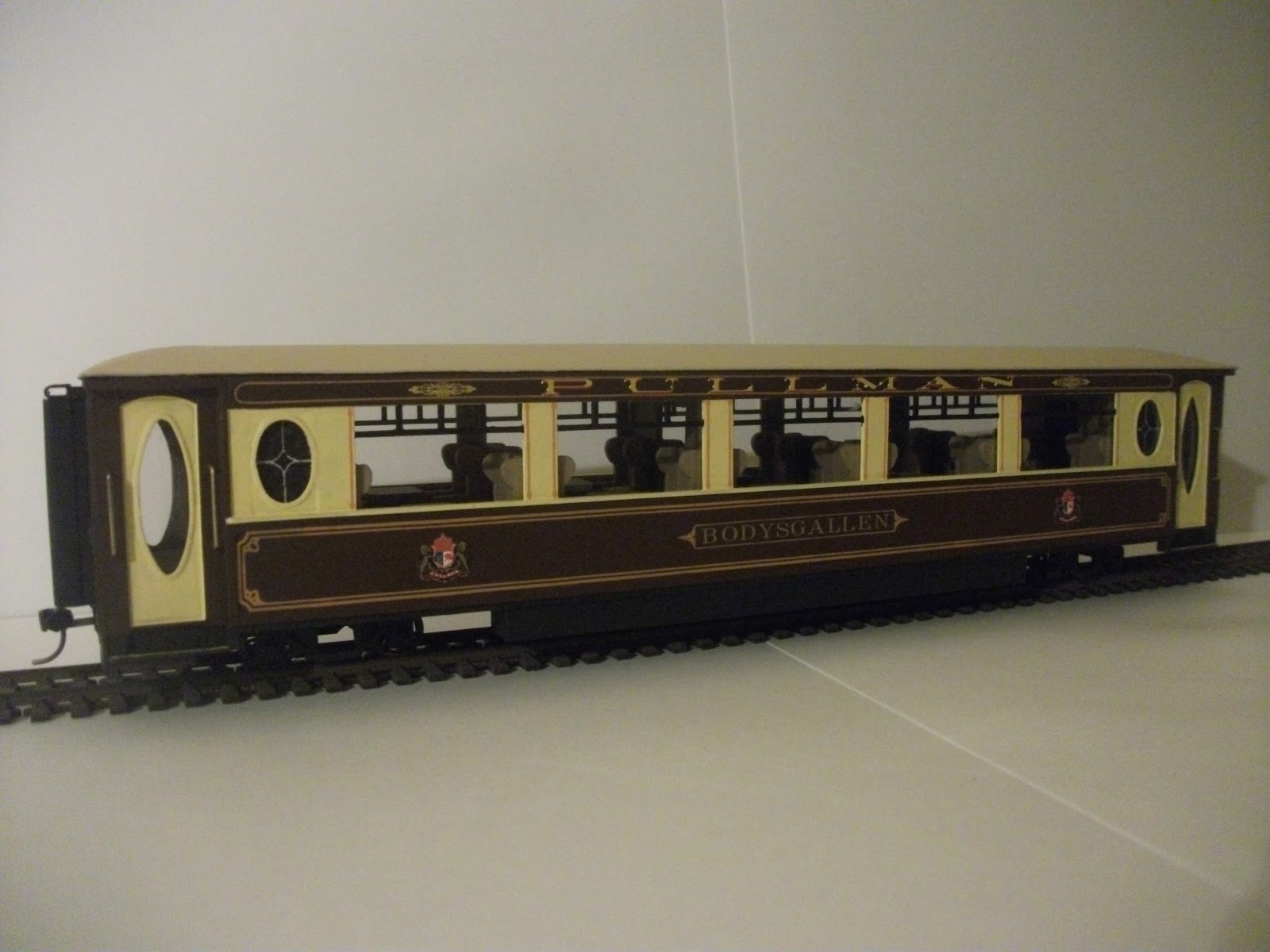
I wasn’t intending to do this but I suppose there’s no particular hurry just now....
Months ago when I was casting the seats for Gwyrfai I couldn’t be bothered to add on the styrene arm rests, reckoning that you can’t really see them anyway.
However, yesterday afternoon when I was meaning to begin fixing the chairs into position in the carriage I decided perhaps it wouldn’t do any harm to add them on?
I think it was probably an avoidance tactic so I didn’t have to commit to setting them in position - there’s always something unsettling about the prospect of getting out the Super Glue I find - not a very subtle modelling material at all...
Showing posts with label WHR Observation Carr. Show all posts
Wednesday, 25 March 2020
Sunday, 15 March 2020
The Importance Of Model Railways
In times like these when there is so much uncertainty, so much than can leave us fearful, I am reminded what a wonderful hobby model railways is.
It occurred to me as I was stubbornly attempting to force flat styrene sheet into a complex curved valance at the front of Gwyrfai that I’d completely forgotten about the Coronavirus and everything that goes with it.
It doesn’t have to be model trains, of course, because any practical hobby which requires you to focus on a task is brilliant therapy at an anxious time in all our lives.
With it looking like so much of our day to day lives are about to enter a prolonged slumber here in the UK (and elsewhere) it might be that I have more time to spend at my workbench, and if I do I shall be glad of it.
You’ll see from the photo that I’ve also applied and shaped the Milliput dome and I think it’s looking quite good, although a coat of primer will soon expose any flaws.
I think the next big job will be to fit the interior which is already cast.
In the meantime everyone...
It occurred to me as I was stubbornly attempting to force flat styrene sheet into a complex curved valance at the front of Gwyrfai that I’d completely forgotten about the Coronavirus and everything that goes with it.
It doesn’t have to be model trains, of course, because any practical hobby which requires you to focus on a task is brilliant therapy at an anxious time in all our lives.
With it looking like so much of our day to day lives are about to enter a prolonged slumber here in the UK (and elsewhere) it might be that I have more time to spend at my workbench, and if I do I shall be glad of it.
You’ll see from the photo that I’ve also applied and shaped the Milliput dome and I think it’s looking quite good, although a coat of primer will soon expose any flaws.
I think the next big job will be to fit the interior which is already cast.
In the meantime everyone...
Friday, 13 March 2020
Over The Top
The roof has been the focus of work on Gwyrfai this week.
In the photo you can see the structure I use with the flat false ceiling, longitudinal ribs and the styrene skin over the top and glued only at each edge.
I’ve also made some shapers to help form the sloped end at the front.
The voids will be filled with Milliput, which although it takes longer to set provides a much smoother and more solid structure than filler ever could.
In the photo you can see the structure I use with the flat false ceiling, longitudinal ribs and the styrene skin over the top and glued only at each edge.
I’ve also made some shapers to help form the sloped end at the front.
The voids will be filled with Milliput, which although it takes longer to set provides a much smoother and more solid structure than filler ever could.
Labels:
Gwyrfai,
Observation Carriages,
WHR Observation Carr
Saturday, 7 March 2020
Plastic Surgery
The camera can be unforgiving sometimes - this is not as rough as it looks when seen with the Mark One eyeball.
I’ve faced the brass former at the front of Gwyrfai with styrene and added the second layer of panelling detail.
The next job will be one of the most testing ones - to fit the roof skin and form the sloping front section.
I’ve faced the brass former at the front of Gwyrfai with styrene and added the second layer of panelling detail.
The next job will be one of the most testing ones - to fit the roof skin and form the sloping front section.
Tuesday, 3 March 2020
Take The Floor
I had one of my most productive days in a while at the weekend getting to grips with the returned Gwyrfai.
The first task was to replace the temporary floor with one that fits all the way to the curved front, which will help to make it more rigid during handling.
I also knocked up the skirts along the side which hide all the brake gear and other ancillaries underneath.
Once that was done I prepared the false ceiling which will be used to secure the top of the body sides and will have the roof skin formers added next.
It is also the base for the domed end which will be shaped in Milliput.
The first task was to replace the temporary floor with one that fits all the way to the curved front, which will help to make it more rigid during handling.
I also knocked up the skirts along the side which hide all the brake gear and other ancillaries underneath.
Once that was done I prepared the false ceiling which will be used to secure the top of the body sides and will have the roof skin formers added next.
It is also the base for the domed end which will be shaped in Milliput.
Labels:
Gwyrfai,
Observation Carriages,
WHR Observation Carr
Sunday, 19 January 2020
Sitting Upright
I’ve got the last of the chairs for Gwyrfai cast, and while the ladies of the house watched a movie I was informed I would find very boring I snuck into the workroom to glue them together.

The bucket seats have a four legged base to be fixed on the bottom and most of the armchairs get put back to back, and all need a front support added as well.
The slightly fiddly job now is to fix two short piece of styrene horizontally to represent the arm rests, and then that’s them done.

The bucket seats have a four legged base to be fixed on the bottom and most of the armchairs get put back to back, and all need a front support added as well.
The slightly fiddly job now is to fix two short piece of styrene horizontally to represent the arm rests, and then that’s them done.
Tuesday, 14 January 2020
Steady Progress
Casting of the interior parts for Gwyrfai continues steadily.
I’ve managed to get a couple of sets cast each day.
The bucket seats for the front are almost done but I’ve got a way to go with the armchairs.
I need 16 in total and before they can be fitted I have to make the arms from pieces of styrene and glue them all on.
Friday, 10 January 2020
Seating Production
I’ve begun casting the seats from the new moulds for the interior of Gwyrfai.
These are quite tricky to cast perfectly.
The tiny legs of the armchairs are very liable to trap tiny air bubbles which have to be chased out with a cocktail stick before it cures - it’s not always possible to get all of them out in time.
Fortunately, the armchairs - which are the most numerous of these pieces - are the most reliable to cast.
These are quite tricky to cast perfectly.
The tiny legs of the armchairs are very liable to trap tiny air bubbles which have to be chased out with a cocktail stick before it cures - it’s not always possible to get all of them out in time.
Fortunately, the armchairs - which are the most numerous of these pieces - are the most reliable to cast.
Wednesday, 8 January 2020
Think Pink
Until the brass work on the front is done there’s not much more I can add to the body of Gwyrfai but I can start work on the interior.
I will use the same castings for the seats as in the latest FR observation cars, but I think it would be wise to make some fresh moulds first.
I have a master for each of the parts which is fixed at the bottom of a styrene box.
They then get buried beneath an RTV silicone rubber which takes roughly a day to set.
It’s a very simple 10:1 ratio mix with a catalyst which is handily coloured red so you can see it’s mixed through properly.
I will use the same castings for the seats as in the latest FR observation cars, but I think it would be wise to make some fresh moulds first.
I have a master for each of the parts which is fixed at the bottom of a styrene box.
They then get buried beneath an RTV silicone rubber which takes roughly a day to set.
It’s a very simple 10:1 ratio mix with a catalyst which is handily coloured red so you can see it’s mixed through properly.
Monday, 6 January 2020
Plastic Meets Metal
With three quarters of the body pieces for Gwyrfai made I can begin to glue them together to start assembling a carriage.
The hardest bit is still to come, which is making the curved front of the obs end.
On Glaslyn I did this all in styrene, and on the FR carriages I made a master for bottom piece and then cast it in resin.
This time I’m going to try a brass former with a styrene skin.
The plan is for Himself to solder in the window pillars and add on a cant rail at the top, but obviously that has to be done before I can add and styrene, and before it can be attached to the rest of the body.
In the meantime I’ve made a floor piece and a temporary clamp to try and keep the rest of the body in shape as much as I can - it’s very flimsy and delicate at the front just now.
The hardest bit is still to come, which is making the curved front of the obs end.
On Glaslyn I did this all in styrene, and on the FR carriages I made a master for bottom piece and then cast it in resin.
This time I’m going to try a brass former with a styrene skin.
The plan is for Himself to solder in the window pillars and add on a cant rail at the top, but obviously that has to be done before I can add and styrene, and before it can be attached to the rest of the body.
In the meantime I’ve made a floor piece and a temporary clamp to try and keep the rest of the body in shape as much as I can - it’s very flimsy and delicate at the front just now.
Labels:
Gwyrfai,
Observation Carriages,
WHR Observation Carr
Thursday, 2 January 2020
At Last The End
The festive season has been a bit of a washout for modelling, but on the last day of the year I found half an hour to have a go at making the basic outline of the corridor end of Gwyrfai
It’s a fabricated piece and the first job is to assemble the pieces I will need, including the solid lower piece and the top piece shaped to the roof profile.
A really good tip is to use a sheet of glass as your surface and use a metal ruler as a guide to make sure your joints are square and straight.
Also make sure you place only the tiniest drop of solvent on the joint - capillary action will do the rest for you.
As well as the ruler I like to use a couple of very precisely measured off cuts as guides to make sure the windows either side a precisely the same width.
Finally, chop the pillars to the exact height you require and glue the top piece in place.
It’s a fabricated piece and the first job is to assemble the pieces I will need, including the solid lower piece and the top piece shaped to the roof profile.
A really good tip is to use a sheet of glass as your surface and use a metal ruler as a guide to make sure your joints are square and straight.
Also make sure you place only the tiniest drop of solvent on the joint - capillary action will do the rest for you.
As well as the ruler I like to use a couple of very precisely measured off cuts as guides to make sure the windows either side a precisely the same width.
Finally, chop the pillars to the exact height you require and glue the top piece in place.
Tuesday, 8 October 2019
The Start Of Something Posh
It’s always a very satisfying moment to make the first cut on a new model, in this case the WHR observation car Gwyrfai which entered service at the FR vintage weekend.
One of the most crucial things for getting this carriage looking right is the step in the body side where the front saloon begins.
What I did was cut two identical, plain long rectangles, then mark the bit to be cut off with a 45 degree angle at the end rather than a curve.
Once that was removed the corner was created by careful use of a round file.
Next I’ll be adding vertical strips of styrene for the window pillars.
One of the most crucial things for getting this carriage looking right is the step in the body side where the front saloon begins.
What I did was cut two identical, plain long rectangles, then mark the bit to be cut off with a 45 degree angle at the end rather than a curve.
Once that was removed the corner was created by careful use of a round file.
Next I’ll be adding vertical strips of styrene for the window pillars.
Wednesday, 2 October 2019
Not Seiont
At last my mole has come up with the goods and I have a document which appears to be an outline plan for the new WHR observation carriage, which in turn means I have a project to work on.
The new carriage is very different in detail from the first one, Glaslyn, although very obviously sharing a family resemblance.
One thing which amused me on the drawing I have is a glimpse it offers into the politics of FR/WHR names.
The first carriage was officially named Glaslyn by no less a personage than HM Queen, who rode in it to Dinas for the ceremony with the carriage marshalled (for security reasons we presume) in the middle of the train, making a mockery of the huge curved window at the front which is the iconic feature of this generation of observation carrs.
The second one, we now know, is to be called Gwyrfai.
In the drawing I have, in the traditional Pullman name space in the middle of the bodyside, it has the words 'Not Seiont'- which is the river which flows into the Menai Strait right past the railway's northern terminus at Caernarfon.
Now, would seem a logical choice given how the Glaslyn flows into Porthmadog Harbour at the other end - or perhaps we should say the middle? - of the line.
It doesn't begin with the letter G, though.
Something tells me there's a story behind this.....
The new carriage is very different in detail from the first one, Glaslyn, although very obviously sharing a family resemblance.
One thing which amused me on the drawing I have is a glimpse it offers into the politics of FR/WHR names.
The first carriage was officially named Glaslyn by no less a personage than HM Queen, who rode in it to Dinas for the ceremony with the carriage marshalled (for security reasons we presume) in the middle of the train, making a mockery of the huge curved window at the front which is the iconic feature of this generation of observation carrs.
The second one, we now know, is to be called Gwyrfai.
In the drawing I have, in the traditional Pullman name space in the middle of the bodyside, it has the words 'Not Seiont'- which is the river which flows into the Menai Strait right past the railway's northern terminus at Caernarfon.
Now, would seem a logical choice given how the Glaslyn flows into Porthmadog Harbour at the other end - or perhaps we should say the middle? - of the line.
It doesn't begin with the letter G, though.
Something tells me there's a story behind this.....
Labels:
Carriages,
Glaslyn,
Gwyrfai,
WHR Observation Carr
Saturday, 6 April 2019
Flat End Society
Himself’s occasional trips to Wales to volunteer on the FR have the added bonus of allowing a chance for a little spying in order to find out what’s coming down the tracks towards us.
On this most recent trip he got a glimpse of the second WHR observation car under construction in the carriage works.
It’s clear there are going to be many differences to ‘Glaslyn’, most obviously at the end where it is of a much flatter profile, and the windows are vertical rather than being raked back, as on the original carriage.
I’m fact, the side view shows that is something of a hybrid, borrowing many styling cues from the latest FR observation cars 150 and 152, but retaining the deep cantrail of the WHR carriages and the very shallow domed end on the roof.
Should be a challenge to make.
On this most recent trip he got a glimpse of the second WHR observation car under construction in the carriage works.
It’s clear there are going to be many differences to ‘Glaslyn’, most obviously at the end where it is of a much flatter profile, and the windows are vertical rather than being raked back, as on the original carriage.
I’m fact, the side view shows that is something of a hybrid, borrowing many styling cues from the latest FR observation cars 150 and 152, but retaining the deep cantrail of the WHR carriages and the very shallow domed end on the roof.
Should be a challenge to make.
Friday, 27 June 2014
Bridge Test Run
Himself has finished off the final river bridge at the back of the layout and, almost as an afterthought, decided to check that the stock would fit through without fouling...
One of our Garratts and the obs carr Glaslyn doing the honours there.
The bridge model has been completed with stone wall capping glued on top of the embossed plasticard side walls.
The irony is this is right at the very back on the layout and facing away from the public - you'll probably never see the bridge from this angle again, but at least we've proved it's there.
This is the side the punters get to see which has had the plaster filling added now.
The safety railings and the mesh walkway will be added at a later date.
One of our Garratts and the obs carr Glaslyn doing the honours there.
The bridge model has been completed with stone wall capping glued on top of the embossed plasticard side walls.
The irony is this is right at the very back on the layout and facing away from the public - you'll probably never see the bridge from this angle again, but at least we've proved it's there.
This is the side the punters get to see which has had the plaster filling added now.
The safety railings and the mesh walkway will be added at a later date.
Friday, 15 February 2013
Pullman Perfection?
These may be the best models we have yet built.
They are a pair of WHR Pullman carriages scratch built from styrene in 7mm scale.
It's been a long term project which has taken around 18 months from the first cut of plastic to the handover to the client.
Himself lent a hand with painting and lining of the completed carriages.
Comments and observations welcome...
They are a pair of WHR Pullman carriages scratch built from styrene in 7mm scale.
It's been a long term project which has taken around 18 months from the first cut of plastic to the handover to the client.
Himself lent a hand with painting and lining of the completed carriages.
Comments and observations welcome...
Monday, 10 September 2012
Pullman Painting Progress
I haven't written recently about the two 7mm scale WHR Pullmans I've been building for a client over the last year or so.
A year? Well, Rome wasn't built in a day, you know, and this pair are going to be very special when they're finished.
Himself kindly offered to deploy his airbrushing talents to finish them off so they've been exported to Oxfordshire where they are in the process of being painted.
Here is 'Bodysgallen' in primer...
And a shot of 'Glaslyn' showing the card template for the glazing in the big end window. Because it is curved and angled back the glazing needs to be cut into a crescent shape.
I can't help noticing that in the process Himself has managed to break off the front vacuum pipe. He really is all fingers and thumbs you know...
(In fairness I should not discount the possibility that he deliberately removed it to make applying the ornate transfers around the front of the carriage easier.)
A year? Well, Rome wasn't built in a day, you know, and this pair are going to be very special when they're finished.
Himself kindly offered to deploy his airbrushing talents to finish them off so they've been exported to Oxfordshire where they are in the process of being painted.
Here is 'Bodysgallen' in primer...
And a shot of 'Glaslyn' showing the card template for the glazing in the big end window. Because it is curved and angled back the glazing needs to be cut into a crescent shape.
I can't help noticing that in the process Himself has managed to break off the front vacuum pipe. He really is all fingers and thumbs you know...
(In fairness I should not discount the possibility that he deliberately removed it to make applying the ornate transfers around the front of the carriage easier.)
Sunday, 20 November 2011
Too Hot To Handrail
Among the sundry details to be completed on 'Glaslyn' are the handrails on either side of the doors at the rear of the carriage.
These are quite tricky things to make because they cannot be done by simply bending one piece of wire into shape. The struts that fix the vertical hand rail are positioned a little way in from the ends.

The only way to replicate this is to cast or etch a single piece or to fabricate it. I have done the latter.
Now, those of you who have been reading this blog for a while will know that me and soldering irons have only recently become acquainted, and making bits like these provides many exciting opportunities to suffer third degree burns.
There is also plenty of scope to muck them up, too. It's vital to make sure that they're all identical and that the struts are all soldered on in the same spots.
Himself had made some in 4mm when completing some of the latest WHR carriages and informed me that they were complete swines to make!
All these considerations led me to one conclusion - I needed a jig.
My solution was to start off by drilling parallel holes into a piece of thin tongue and groove to hold the struts...

Not only would this guarantee I could make each of the handrails identical it would also do most of the holding for me, which is just as well because I definitely don't have asbestos fingers!
Here you can see the wire being offered up to complete the handrail...

A dollop of solder on each of the joints and the job's a good'un. Here are all four now made up...

Here's how they look on the model during a trial fitting..
These are quite tricky things to make because they cannot be done by simply bending one piece of wire into shape. The struts that fix the vertical hand rail are positioned a little way in from the ends.

The only way to replicate this is to cast or etch a single piece or to fabricate it. I have done the latter.
Now, those of you who have been reading this blog for a while will know that me and soldering irons have only recently become acquainted, and making bits like these provides many exciting opportunities to suffer third degree burns.
There is also plenty of scope to muck them up, too. It's vital to make sure that they're all identical and that the struts are all soldered on in the same spots.
Himself had made some in 4mm when completing some of the latest WHR carriages and informed me that they were complete swines to make!
All these considerations led me to one conclusion - I needed a jig.
My solution was to start off by drilling parallel holes into a piece of thin tongue and groove to hold the struts...

Not only would this guarantee I could make each of the handrails identical it would also do most of the holding for me, which is just as well because I definitely don't have asbestos fingers!
Here you can see the wire being offered up to complete the handrail...

A dollop of solder on each of the joints and the job's a good'un. Here are all four now made up...

Here's how they look on the model during a trial fitting..
Subscribe to:
Posts (Atom)